The most interesting part of NVIDIA’s latest cooling message is not the headline temperature. It is the strategic assumption underneath it.
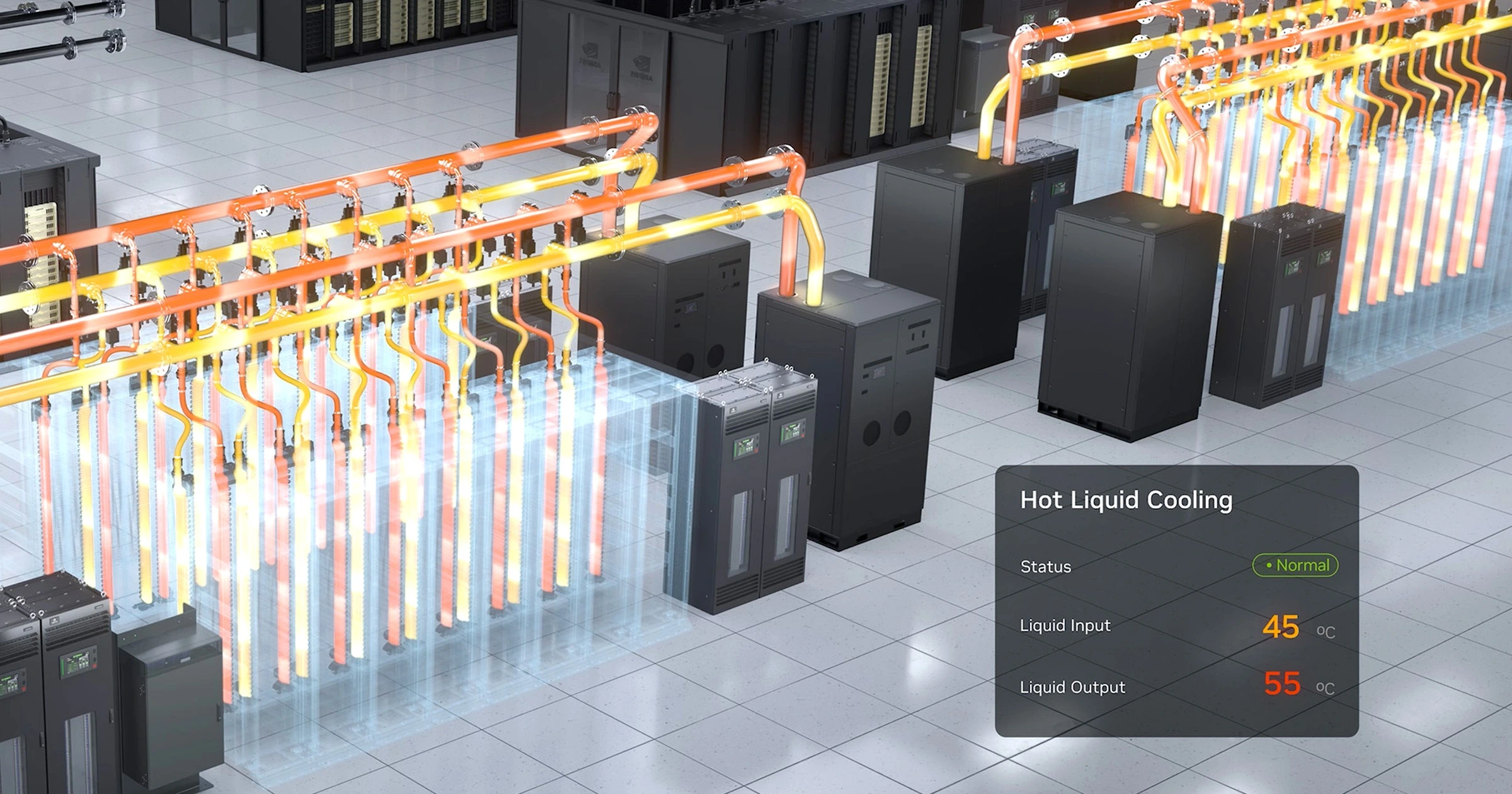
In its June 21 post, NVIDIA said its newest AI servers can run cooling liquid at up to 45°C and framed the Rubin generation as the first 100% liquid-cooled AI infrastructure, with every chip and networking component cooled by liquid in a closed loop with no fans anywhere in the system. That is not just a component-level improvement. It is a statement about what an AI factory should look like.
The key shift is simple: once the coolant can arrive hot and still do the job, the facility around the compute stack can be simpler, less water-intensive, and in some climates less dependent on mechanical chilling.
That matters because AI infrastructure is no longer a server procurement story. As I argued in what the numbers say about NVIDIA becoming a data-center company, the center of gravity has moved from chips in isolation to full systems and the infrastructure wrapped around them. Cooling is now part of the product.
Hotter coolant changes the cost stack
Traditional data-center cooling logic was built around keeping air cold enough to protect the hardware. That mindset created a large supporting machine: fans, cold aisles, hot aisles, chilled-water plants, and in many cases evaporative cooling towers.
NVIDIA’s pitch is that 45°C liquid changes that equation because heat is captured directly at the source and moved through liquid loops that can operate at much higher temperatures than conventional air-cooled environments tolerate. If that works at scale, the benefit is not merely better thermals inside the rack. It is fewer thermal penalties outside the rack.
The ENERGY STAR guidance on raising temperatures helps explain why this matters. The agency notes that data centers can save 4% to 5% in energy costs for every 1°F increase in server inlet temperature, and that higher set points increase the hours when air-side or water-side economizers can be used. NVIDIA is not talking about ordinary server inlet air here, it is talking about direct liquid cooling. But the principle is the same: the warmer the cooling loop can safely run, the less heroic the rest of the cooling plant has to be.
That is why 45°C is an economic number, not just an engineering number.
This is a chiller story
NVIDIA’s most consequential claim is that, in favorable climates, a 45°C liquid-cooling architecture can enable chiller-less operation with dry coolers. In plain English, instead of relying on water-hungry cooling towers and energy-intensive chillers as the normal state, some AI facilities could reject heat with much simpler external equipment for much of the year.
That changes three things at once.
First, it reduces parasitic energy use. Cooling has long been one of the biggest non-IT loads in a data center. If the facility needs less compressor-driven cooling, more of the site’s power budget can go to compute.
Second, it changes site selection economics. If you can run warm liquid loops and reject heat with dry coolers for more hours, climate becomes an even more explicit part of AI deployment strategy. A site that once looked thermally mediocre may become much more attractive if the cooling design is optimized for high-temperature liquid.
Third, it alters capital planning. Chillers, cooling towers, and the plumbing around them are not small line items. If operators can downsize or reduce reliance on that equipment, the facility design can move faster and the total build can become easier to standardize.
That fits NVIDIA’s broader DSX positioning. On the NVIDIA DSX platform page, the company describes AI factory design as a full-stack problem focused on the lowest token cost, combining reference designs, simulation, and operations across compute, power, cooling, and facility infrastructure. That is the right lens for this announcement. The 45°C claim is not really about making cooling sound clever. It is about pushing cooling into the same optimization stack as compute throughput and power delivery.
Water is the underappreciated variable
Power gets the headlines. Water should get more of them.
NVIDIA says its DSX reference design can use dry-cooler-based closed loops with no evaporative water cooling, and that in some setups water consumption can be near zero, with chillers needed only for a small fraction of the year in some climates. That is a major claim because water is becoming a harder constraint for AI expansion, especially where communities and regulators are increasingly sensitive to industrial water use.
This is where the hotter-coolant story becomes a political and permitting story.
A conventional cooling-tower approach ties high-density compute growth to steady water consumption. A dry-cooler-based closed loop does not eliminate every environmental tradeoff, but it can dramatically reduce one of the most contested ones. For cloud operators, that means less exposure to water-related scrutiny. For enterprises building dedicated capacity, it means more options in regions where water access is either expensive, regulated, or reputationally fraught.
In other words, hotter liquid does not just change operating expense. It changes where AI capacity can be built without creating the same level of friction.
No fans means a different machine, not just a better rack
NVIDIA also says Rubin is designed with no fans anywhere in the system. That matters because it signals a break from the hybrid world where liquid is added but the machine is still fundamentally organized around moving cold air.
Once you remove fans and stop designing the system around cold aisles, the rack stops being a slightly improved version of an old data-center object. It becomes a different thermal appliance. Noise profiles, airflow choreography, white-space layout, and service assumptions can all change.
That will not make retrofits trivial. Existing facilities were not all built for this. But it does suggest that greenfield AI sites will increasingly be designed backward from liquid loops rather than forward from room air.
That is one reason the AI infrastructure race is starting to look like a utility-and-facilities competition as much as a semiconductor competition. It is also why adjacent developments, from massive compute contracting to automation inside cloud operations, matter in the same picture. You can see that logic in what Google’s reported $920 million monthly AI compute commitment implies and in how AWS is putting security and DevOps agents into production: AI capacity is becoming operational infrastructure, not just a product feature.
The practical takeaway
NVIDIA is trying to move the market toward a new default: hotter coolant, fewer fans, less chiller dependence, and much lower water use where climate and facility design allow it.
If that model holds, the winners in AI infrastructure will not just be the companies with the fastest accelerators. They will be the operators who can turn thermal design into lower token cost, faster deployment, and easier permitting.
For cloud providers, cooling architecture is now a competitive lever. For colocation and infrastructure buyers, rack density can no longer be evaluated separately from water strategy and site climate. And for enterprises building AI capacity, it means the right procurement question is no longer just “Which GPU cluster do we want?” It is “What cooling system are we implicitly buying with it?”
That is the real significance of 45°C. It is not hotter coolant for its own sake. It is a bid to redesign the economics of the AI factory around the thermal system.
Sources
- NVIDIA Blog, “Hotter Than a Hot Tub: The 45°C Breakthrough to Cool AI’s Biggest Machines”, published June 21, 2026.
- NVIDIA, “AI Factory Design, Simulation, and Operations | NVIDIA DSX Platform”.
- ENERGY STAR, “Raise the Temperature”.