Most AI announcements still arrive as demos, benchmarks, or recycled promises about productivity. The new NVIDIA-AWS message is more interesting because it talks about something harder: production.
Not production as a slideware concept, but production in the expensive, operational sense: latency, vector indexing, query cost, inference throughput, training capacity, and infrastructure that behaves predictably when real traffic shows up.
The announcement brings together three developments that would each matter on their own. First, Amazon EC2 G7 instances are now generally available with NVIDIA RTX PRO 4500 Blackwell Server Edition GPUs. Second, GPU acceleration in Amazon OpenSearch is turning vector indexing into a less painful part of the stack. Third, AWS says it has achieved NVIDIA Exemplar Cloud status for GB300 training workloads, which is effectively a confidence signal for buyers trying to separate tuned infrastructure from marketing noise.
The useful reading is not “NVIDIA and AWS expanded their partnership.” The useful reading is that both companies are trying to package a less handmade path from AI pilot to AI production.
The bottleneck was never only the model
Over the last year, the market has spent too much time talking about models and not enough time talking about the system that has to keep those models useful once the demo ends.
Good models are not scarce anymore. Operationally coherent AI systems still are.
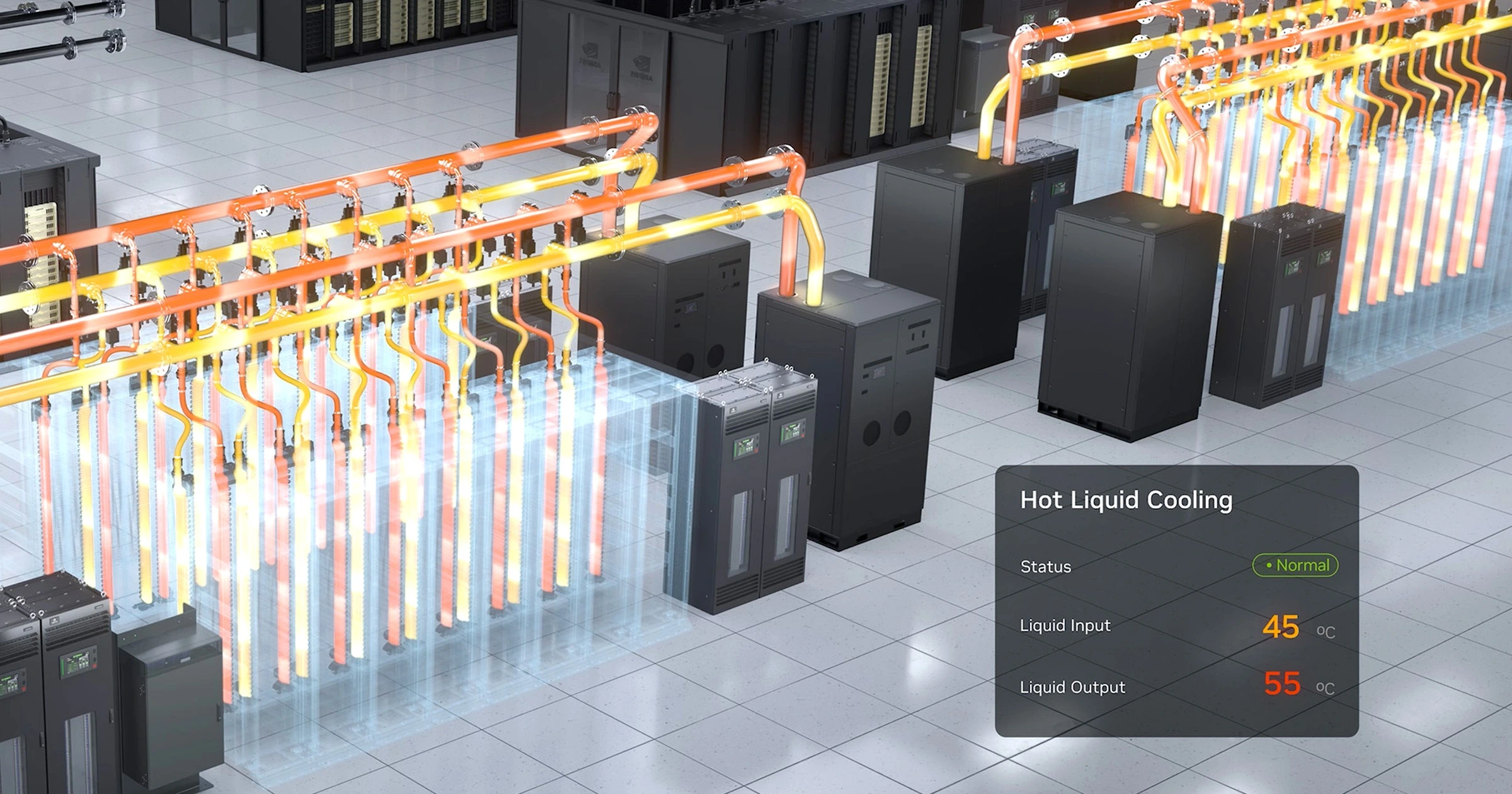
That is what connects this announcement to several recent themes on OpenMedeiros. In what Google’s reported $920 million monthly AI compute commitment implies, the core idea was that compute is becoming an industrial input rather than a normal cloud expense. In why NVIDIA’s 45°C liquid cooling push matters, the issue was the physical layer of AI infrastructure. And in why Web Search on Amazon Bedrock AgentCore is more than another connector, the real story was the tool layer around agents, not the model itself.
This NVIDIA-AWS move sits at the intersection of all three. It suggests that the AI race is becoming less about who can ship the flashiest model and more about who can make inference, retrieval, and training behave like a coherent operating system.
EC2 G7 is not just another GPU SKU
AWS’s G7 announcement looks modest at first glance: up to eight NVIDIA RTX PRO 4500 Blackwell Server Edition GPUs, up to 256 GB of total GPU memory, as much as 700 Gbps of EFA networking, and a positioning story that spans inference, graphics, video, spatial workloads, and GPU-accelerated analytics.
G7 appears designed for teams that do not necessarily need the most exotic frontier-training cluster, but do need a production-grade compute layer for inference, recommendation systems, analytics pipelines, media workloads, and mixed GPU applications. AI budgets do not break only at training time. They also break when organizations need to serve live workloads all day, handle variable demand, move data through pipelines, and keep latency under control without building a miniature GPU-operations company inside the business.
NVIDIA says G7 delivers up to 4.6x better AI inference performance and up to 2.1x graphics performance relative to G6. The exact gain will obviously vary by workload. But the strategic message is clear: Blackwell is being pushed as a practical production layer, not just an aspirational hardware milestone.
Retrieval is becoming the least sexy and most important problem
The most underestimated part of the announcement is OpenSearch.
AWS says GPU acceleration in Amazon OpenSearch can build vector databases up to 10 times faster at roughly a quarter of the indexing cost compared with non-GPU approaches. In a market obsessed with model launches, that can sound like background plumbing. It is not.
For many enterprise AI applications, especially RAG systems, semantic search, recommendations, and agents that depend on current context, the vector layer is where promising projects quietly bog down. If large-scale indexing remains slow, expensive, and operationally annoying, the entire product becomes harder to refresh and harder to trust. If indexing becomes much faster and cheaper, teams can update more often, test more aggressively, and keep larger knowledge bases live without treating every refresh as a special event.
That matters because production AI is not just a model problem. It is a retrieval problem with model consequences.
A model can be excellent and still feel mediocre if the retrieval layer is stale, thin, or too expensive to maintain properly. What AWS is doing here is important precisely because it tries to turn a specialized optimization into a more standard platform capability.
That is the kind of infrastructure improvement that changes product quality quietly. Answers become fresher. Pipelines become less painful to operate. The cost of iteration falls. And a product that was previously stuck in pilot territory has a better chance of surviving contact with actual usage.
Exemplar Cloud matters less as a trophy and more as a trust signal
NVIDIA’s Exemplar Cloud framing for AWS GB300 training could be dismissed as partner-badge marketing. That would be too shallow.
Training at scale is still a zone where glossy promises often collide with inconsistent throughput, networking bottlenecks, bad tuning, and ugly cost surprises. When NVIDIA says AWS has reached Exemplar Cloud status for GB300, the implication is not merely that the partnership is close. The implication is that AWS wants buyers to believe its infrastructure clears a higher bar of optimization against NVIDIA’s own reference expectations.
That is meaningful for enterprise procurement.
The real question for serious buyers is not just which cloud claims to support the newest hardware. It is which cloud can deliver something close to reference-grade performance without forcing the customer to discover every systems bottleneck the hard way.
The larger move: AWS wants to sell less assembly, more path
The strongest part of this announcement is that it spans three layers of the stack at once.
At the inference and mixed-workload layer, there is EC2 G7. At the data and retrieval layer, there is GPU-accelerated OpenSearch. At the frontier-training layer, there is the GB300 Exemplar Cloud story.
That creates a much stronger message than a simple product refresh. AWS wants to be seen not merely as a place to rent compute, but as a place where customers can buy a more prepared path to production AI.
That positioning matters because the market is moving out of the phase where nearly everything was a high-touch engineering experiment. Companies increasingly want AI stacks that do not depend on constant heroics to stay alive. They want fewer bespoke integrations, less handcrafted tuning, fewer ugly surprises when usage grows, and a cleaner relationship between spend and output.
NVIDIA benefits because its hardware and libraries become part of a full-system story instead of isolated components. AWS benefits because hardware, retrieval, and training all become part of one operational argument. And the customer, at least in theory, gets a clearer route out of pilot mode.
What this changes for developers and companies
For engineering teams, the announcement points toward an important simplification: less need to treat each AI layer as its own semi-detached project.
If a company needs to serve inference, maintain a large vector store, and still think about heavyweight training or fine-tuning, fragmentation becomes a hidden tax. Every isolated layer creates extra tuning, extra observability stitching, more room for bottlenecks, and more waste.
Once infrastructure starts being sold as a coherent stack, the planning question improves. Instead of asking only “which model should we use?”, teams start asking “what operating path do we want for retrieval, serving, and training?” That is a much better question.
For businesses, the practical implication is also clearer than the hype. The announcement does not mean AI suddenly became cheap. It means some of the most irritating production bottlenecks are increasingly being treated as platform product, not as integration debt dumped on the customer.
What to watch next
The next thing to watch is real adoption.
Will G7 become a natural production choice outside the obvious graphics and media workloads? Will OpenSearch’s acceleration hold up in less curated enterprise conditions? Will Exemplar Cloud status influence serious buying decisions, or remain mostly a partner-marketing artifact?
Those are open questions. But the direction already matters.
This announcement shows the center of AI competition continuing to move away from the isolated model and toward the full operating system of production. The companies that reduce the most friction between compute, retrieval, and training are likely to capture more value than the companies that only sell abstract intelligence.
That is what NVIDIA and AWS are really offering here: not a futuristic vision of AI, but a less improvised way to keep it working in the real world.