AWS’s launch of Web Search on Amazon Bedrock AgentCore is easy to misread as a standard product update. On the surface, it sounds familiar: agents can now query the live web instead of relying only on training data.
That matters, but the more interesting story is not that AWS added search. It is how AWS chose to add it.
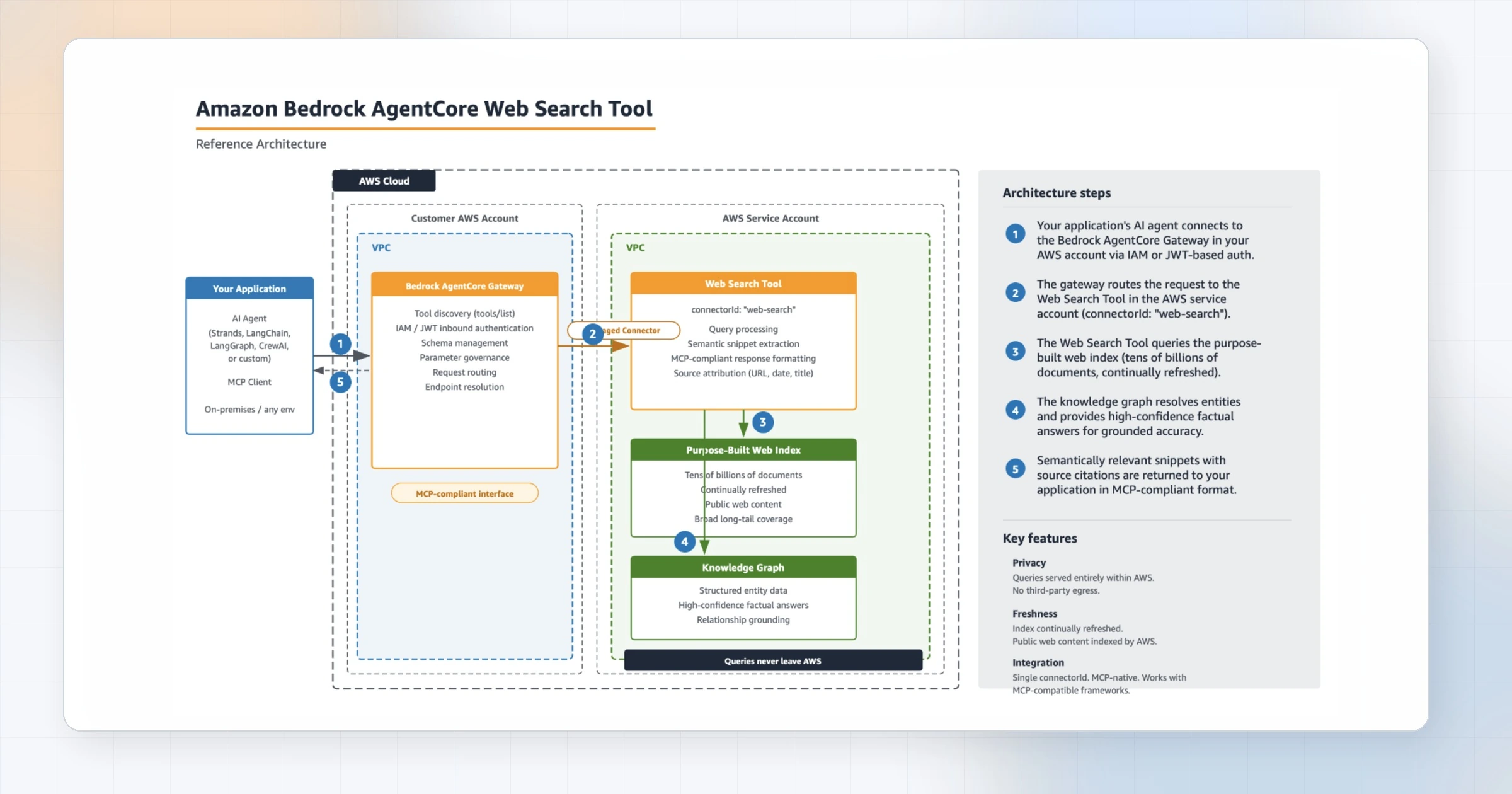
What the company is building inside AgentCore is not just a connector to somebody else’s search engine. It is an attempt to turn live web retrieval into a native enterprise capability: MCP-compatible, exposed through AgentCore Gateway, backed by an Amazon-operated index, and designed so customer queries stay inside AWS.
The problem was never just stale model knowledge
The obvious use case for web search in agents is freshness. A model trained months ago cannot know today’s product announcement, price change, outage, or executive move.
But freshness alone does not explain why enterprise teams have often been slow to add live web retrieval to production agents.
The real blocker is operational trust.
A developer can wire an agent to a generic search API in an afternoon. What takes longer is everything around that demo: which provider receives the queries, where the logs live, how snippets are extracted, whether results are structured enough for reliable citations, whether search behavior is governable at the tool boundary, and whether security teams are now inheriting one more unvetted data egress path.
That is why this release matters. AWS is trying to collapse those concerns into platform infrastructure instead of leaving each team to solve them ad hoc.
AWS is making web retrieval part of the Gateway layer
In AgentCore, Web Search shows up as a built-in connector target on Gateway using the Model Context Protocol.
When search is exposed as a native MCP tool, developers do not need a custom wrapper just to make it discoverable. Agents call tools/list, see the Web Search tool, and invoke it with a simple schema: a required query string and an optional maxResults field from 1 to 25. The response comes back with structured results that include text snippets, source URLs, titles, and publication dates.
That creates a very different developer experience from “paste in a third-party search SDK and hope the model uses it well.” It also creates a different governance surface. Search is no longer something living outside the platform in custom glue code. It becomes another Gateway-mediated capability, which is why this launch also echoes a point I made earlier in Why OpenAI on AWS matters less as distribution and more as enterprise workflow capture: in enterprise AI, the strategic layer is rarely the model alone. It is the workflow boundary, the tooling boundary, and who controls both.
Web search entering that same boundary is the important shift.
This is not a thin wrapper over somebody else’s engine
AWS is explicit that Web Search on AgentCore is backed by an Amazon-operated web index spanning tens of billions of documents. The company also says the index is refreshed continuously, with new and changed content reflected within minutes.
That matters for two reasons.
First, it changes the dependency model. Many agent search features are effectively reskinned access to an external engine. AWS is making a stronger claim here: the retrieval layer itself is part of Amazon’s own stack.
Second, it gives AWS room to optimize for agent consumption instead of general consumer search behavior. The documentation emphasizes semantic snippet extraction tuned for model context windows, plus knowledge graph grounding for entity-level facts. In plain terms, the goal is not to send an LLM a messy page dump and hope it figures things out. The goal is to send compact, relevant passages and high-confidence factual anchors that are easier to cite and less likely to drift.
Zero data egress is not a marketing footnote
The strongest enterprise signal in the launch is AWS’s insistence that queries never leave AWS. In the release notes, the company frames this as zero data egress. In the documentation, it states directly that customer queries are not sent to a third-party search engine or routed outside AWS.
For enterprise teams, that is architectural relief.
Search queries are often more sensitive than they look. They can reveal internal initiatives, investigation topics, product timelines, customer issues, or security questions long before any formal document exists. Once you accept that, the idea of letting agents freely ship those queries to outside search providers starts to look less like convenience and more like exposure.
That is also why governance cannot stop at “better retrieval.” The risk is not only bad answers. It is what the agent reveals while trying to get better answers. If you want a concrete example of how ordinary retrieval behavior can become a leak path, see MosaicLeaks shows how deep research agents can leak secrets through ordinary web queries. AWS is not solving every retrieval risk here, but it is clearly trying to remove one major class of it: unnecessary third-party query egress.
Why product teams should care
If you are already standardizing on AgentCore, Web Search reduces the amount of integration plumbing needed to ship a current-events-aware agent. There are no outbound search credentials to manage, no result-shaping layer to build, and no separate discovery path for MCP clients. The tool can sit beside internal tools, managed knowledge bases, and other Gateway targets in one agent architecture.
That matters even more in the broader June 2026 AgentCore context. AWS is shipping Web Search alongside generally available Harness, policy support for Bedrock Guardrails, evaluations, and managed knowledge bases. The pattern is visible: AgentCore is becoming less a collection of raw primitives and more a governed assembly layer for production agents.
Why governance teams should care
Security and governance teams should pay attention to a different set of details.
The input schema is narrow. The results are structured. Publication dates are preserved. Source links are part of the output. Domain filtering is documented through a denylist. AWS also states that end-user outputs using search results must retain and display the source citations and links that the tool provides.
None of that makes web retrieval automatically safe. But it does make it more governable.
Enterprise governance is rarely about blocking a capability outright. More often, it is about turning a messy capability into one that can be constrained, logged, reviewed, and explained. A web retrieval tool that lives inside Gateway and behaves like the rest of the MCP tool layer is much easier to reason about than bespoke search integrations scattered across agent codebases.
The real significance
The biggest takeaway from this launch is that AWS is treating live web retrieval as infrastructure, not as an add-on.
Once agents move beyond demos, the hardest questions are not “can the model search?” but “where does that search happen, what leaves the boundary, how is it exposed to the agent, what shape do the results take, and who governs the behavior over time?” Web Search on Amazon Bedrock AgentCore is AWS’s answer to those questions, at least for teams willing to build inside its stack.
The winning platforms may not be the ones with the most tools in a catalog. They may be the ones that make useful tools feel native, governable, and operationally boring.
That kind of boring is exactly what many enterprises need.