AWS just published one of the more honest agent-infrastructure posts of the month.
The official topic is Amazon Bedrock AgentCore Observability, but the deeper point is not the dashboard itself. It is the implicit admission that the hardest part of production agents is no longer just prompting. It is figuring out why they looped, why they chose the wrong tool, why they spent too many tokens, and why all of that happened without triggering the kind of error a normal monitoring stack would catch.
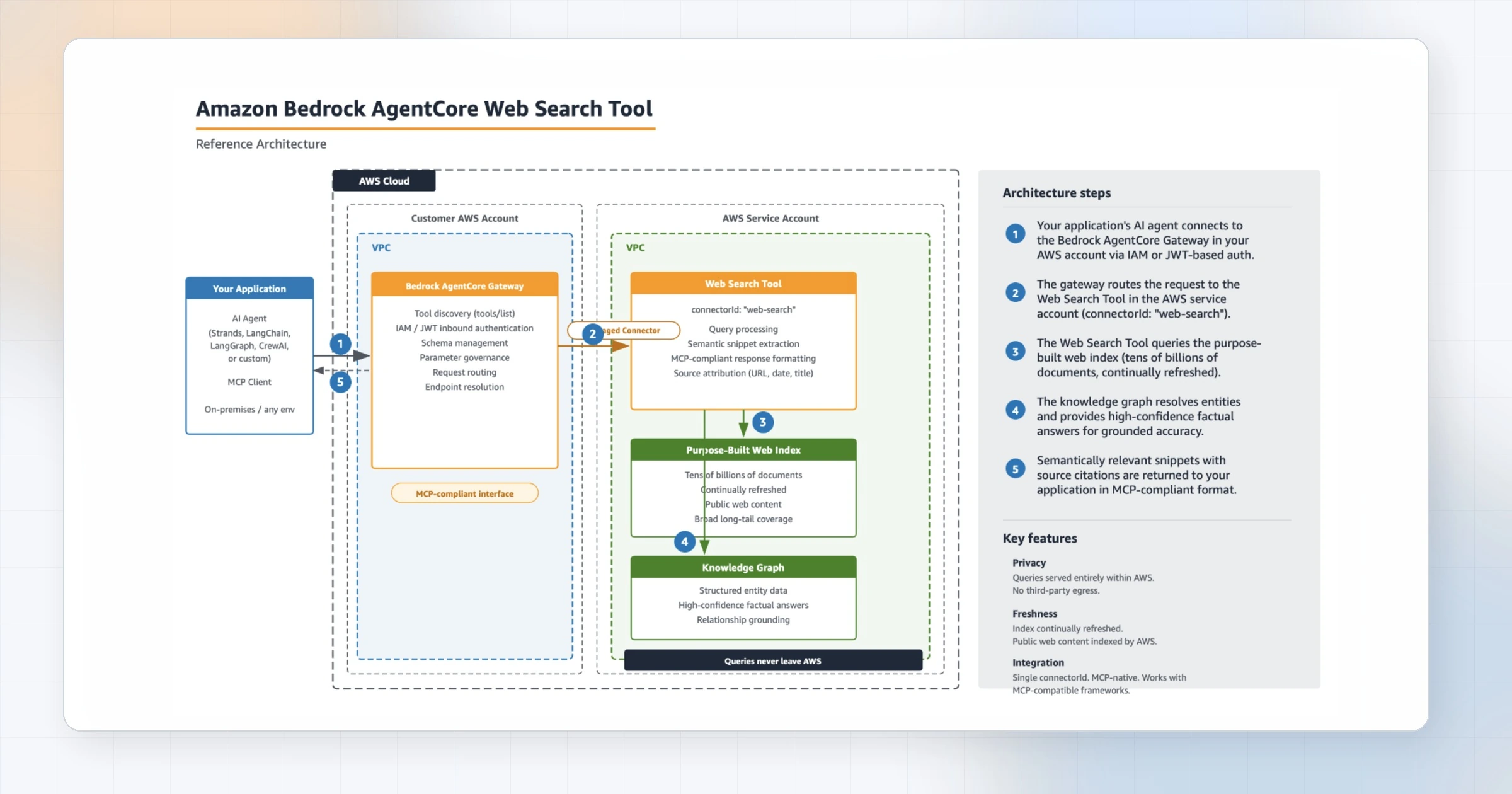
That matters because a lot of teams still talk about agents as if they were just more capable chat interfaces. In production, they look much more like distributed systems with memory, tools, retries, policies, sessions, and cost surfaces that compound over time. The same broader shift was already visible in Amazon Bedrock AgentCore web search for enterprise retrieval: once an agent gets stronger access to external context, the next question is not only what it can do, but how you inspect what it actually did.
AWS’s failure model is more useful than the product name
The best part of the AWS material is not the feature list. It is the way the company breaks agent failures into three operational buckets: quality, reliability, and efficiency.
Quality failures are the most deceptive. The agent completes the task, the system records success, but the answer is wrong, incomplete, or fabricated. That is dangerous precisely because it does not look like an outage. It looks like a healthy system delivering quietly bad work.
Reliability failures are the ones that stop the workflow from closing. AWS points to tool invocation problems, bad credentials, missing permissions, invalid inputs, and context loss across sessions. At that point the issue is not that the model “wasn’t smart enough.” The issue is that the agent behaved like unstable software.
Efficiency failures are where the budget starts to bleed. High latency, long sessions, bloated retrieval, and excessive token usage may not visibly break the flow, but they can destroy the unit economics of an otherwise promising product. That connects directly to GitHub’s recent harness argument about cost per task: agent quality only matters commercially if the surrounding system can deliver it at a cost profile that survives scale.
The most revealing example is the silent loop
AWS includes a concrete example that deserves attention because it avoids the usual cartoon version of “AI failure.” In one scenario, the dashboard shows 266.9K total tokens consumed with a 0% error rate.
That is the point.
Nothing crashed. No fatal exception fired. A traditional success/failure graph could easily make the session look healthy. But the agent had entered a loop and kept burning tokens without finishing the work.
This is one of the core production-agent problems. A loop is not always a dramatic failure. Sometimes it is just a system that keeps trying, keeps spending, and keeps missing the stopping condition. In AWS’s example, the root cause was a system prompt that effectively told the agent not to give up, but never established a meaningful termination rule.
That sounds like a small prompting mistake, but it exposes a much bigger shift. Agent engineering is moving beyond prompt phrasing into termination design, retry discipline, loop detection, and traceable execution logic.
It also helps explain why MosaicLeaks and similar agent-security cases matter beyond the narrow security headline. Once agents gain autonomy, every bad decision path becomes an operational issue. Without observability, you usually discover that too late.
Metrics, traces, and logs do different jobs
The stack AWS is describing is familiar in mature software, but many teams still have not fully applied it to agents.
Metrics tell you when something is drifting. Session volume, latency, duration, token counts, and error rates help answer the first question: is the system behaving differently from normal?
Traces answer the question engineers actually lose time on: what happened in this specific execution? AWS talks about following reasoning steps, tool calls, memory retrievals, and final outputs across a session. That is what starts turning an agent from black box into production software you can actually investigate.
Structured logs help isolate repeatable failure patterns and make alerting more actionable. They let you search for repeated tool calls, group error types, measure abnormal retries, and build alarms around behavior instead of vague intuition.
One detail that matters a lot is AWS’s use of OpenTelemetry-compatible telemetry routed to CloudWatch by default. That is a sign of product maturity. Agent telemetry is not being treated as novelty data. It is being placed inside the same operational discipline teams already use for backend services, APIs, queues, and workers.
What changes for teams shipping agents today
The biggest shift is conceptual.
If you still evaluate agents mainly through benchmark screenshots or satisfaction scores, you are observing them too late. Before user delight, there is execution health. Before “did the answer look smart,” there is “did the system terminate correctly, call the right tool, preserve session state, and stay inside a sane token envelope?”
In practice, four questions become more important.
First: what are the explicit stopping conditions for the flows that matter most? If a step fails, how many retries are acceptable before the agent stops or escalates?
Second: which tools produce the most latency, retries, or permission failures? A lot of so-called model failure turns out to be tool ambiguity, bad interface design, or weak runtime control.
Third: what does a normal token budget per useful session actually look like? Without a baseline, runaway cost often hides in plain sight.
Fourth: which session patterns deserve alarms? AWS’s examples make a strong case for watching latency percentiles, duration spikes, and abnormal token growth. Silent loops do not wait for postmortems.
This also reinforces a broader pattern across the agent stack. Durable competitive advantage is not only about model access. It is about system quality around the model: tool boundaries, execution control, tracing, governance, and cost discipline. That is the layer where products stop being impressive demos and start becoming dependable software.
The honest reading of the launch
AgentCore Observability does not magically solve production agents. And AWS is not inventing the idea that agents need tracing.
What the company is doing, though, is important. It is acknowledging that autonomy without observability is operational debt. The launch is really about giving teams a way to survive agent behavior once it leaves the lab and starts touching real workflows, real tools, and real budgets.
If the market keeps moving in this direction, the key question will sound different soon.
Not “which model looks smartest?”
But “which system can I observe, constrain, debug, and afford when it runs all day?”
That is a much better question. And right now, it may be the one that matters most.
Sources
- AWS Machine Learning Blog, “Debugging production agents with Amazon Bedrock AgentCore Observability”
- Amazon Bedrock AgentCore Docs, “Observe your agent applications on Amazon Bedrock AgentCore Observability”