Google has decided to move a piece of the AI stack that many teams still treat like background plumbing.
In its new framing, the database is no longer just where records live. It becomes the context engine for the agentic era.
That wording matters.
It signals where the market is trying to find real leverage after the first wave of model hype. If an agent has to reason, call tools, look up history, retrieve relationships, search text, and act on live business data, then the problem stops being only “which model should we use?” and becomes “where does this agent get trustworthy context without bouncing across five separate systems?”
That is exactly where Google now wants Spanner to sit. In its June 30 post, Google Cloud presents Spanner as a unified home for relational data, vectors, graphs, key-value access, and full-text search. The core pitch is easy to understand: stop treating a transactional database, vector store, graph engine, and search layer as if stitching them together is always the smartest default.
The database is back at the center of the agent conversation
For a while, applied AI discussion revolved around models. Then it moved to orchestration frameworks and agent runtimes. Now it is landing, more seriously than before, on the data layer.
You could already see that in Google’s earlier push to turn managed agents in the Gemini API into a product category. This new Spanner positioning completes that story. A vendor does not just want to sell you a runtime and a model endpoint. It wants to sell you the context substrate underneath the agent as well.
Google’s argument is that fragmented architectures create needless friction. One system holds the operational data. Another holds embeddings. A third handles graph relationships. A fourth manages text search. Then you add ETL jobs, sync rules, permission drift, latency buildup, and a growing pile of integration logic. Anyone who has worked on serious RAG or agent systems knows that this is not an abstract problem.
That is why the announcement is worth paying attention to. Not because “multi-model” is automatically impressive, but because Google is trying to package a real architecture pain into a concrete product story.
Where the Spanner argument gets strong
The most persuasive part of the announcement is interoperability.
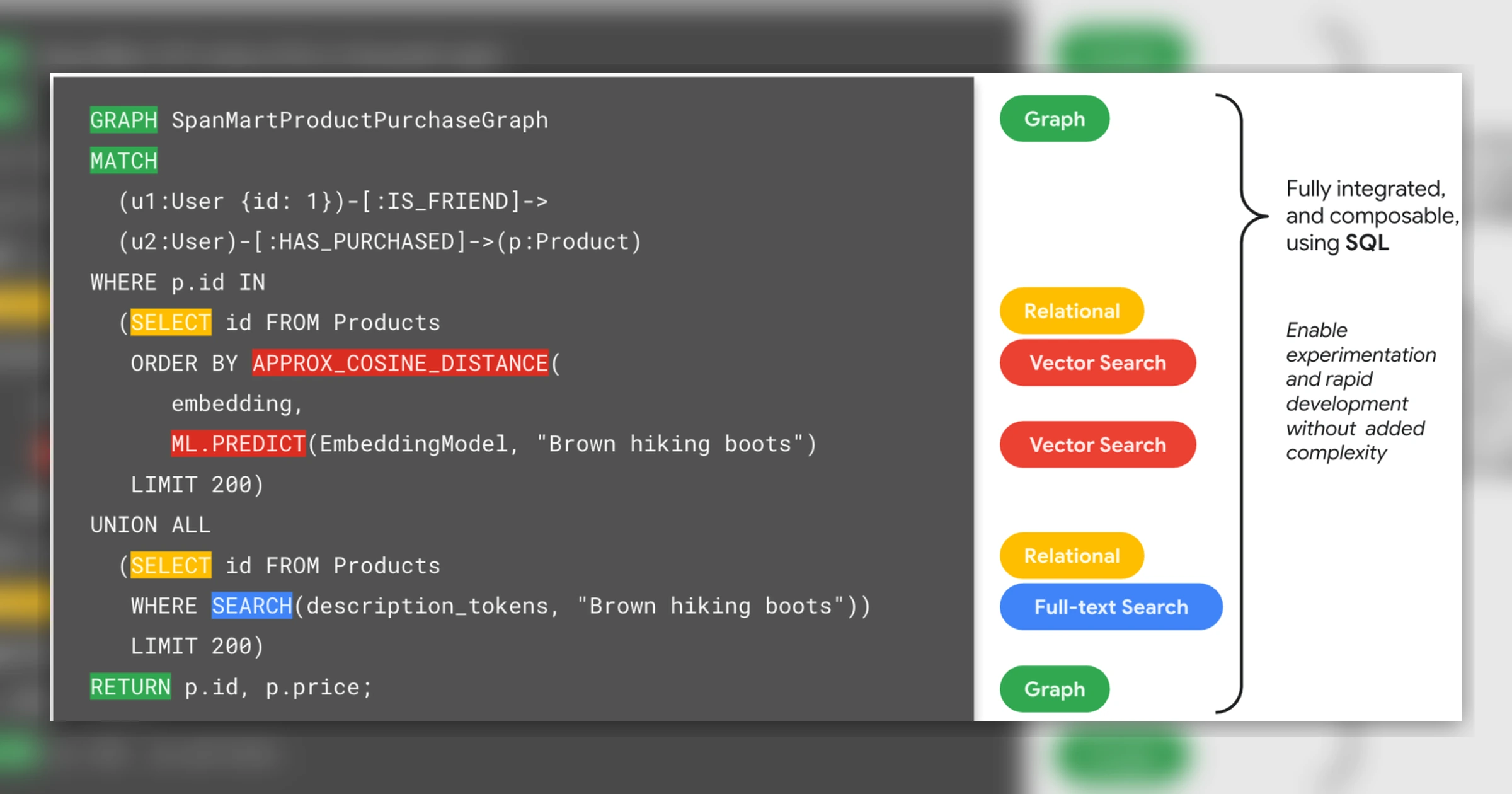
Spanner Graph supports an ISO GQL-compatible interface and lets teams map relational tables into property graphs through declarative schema, without data migration. That is a meaningful detail. Instead of duplicating data or building a separate pipeline just to materialize a knowledge graph, teams can layer graph access on top of existing tabular data and combine SQL and GQL depending on the query.
That is the difference between “we added graph features” and “graph actually talks to the rest of the system.” Google is clearly pushing the second idea.
The same pattern shows up in search. Spanner’s documentation already lays out hybrid full-text and vector search patterns, including rank fusion and reranking approaches inside the same environment. That matters because Google is not pitching a database with a few disconnected add-ons. It is pitching a system where semantic retrieval, keyword matching, relationship traversal, and transactional data live in the same operational plane.
That lines up with a broader industry move. AWS has been addressing similar problems from another direction, as we discussed in its effort to bring native enterprise retrieval into AgentCore web search. AWS is tightening retrieval around the runtime. Google is trying to pull more of the retrieval problem down into the data layer itself.
GraphRAG is the clearest reason this announcement matters
If there is one concept that explains Google’s timing, it is GraphRAG.
Classic RAG works well when similarity search is enough. It breaks down when the question depends on relationships: supplier dependencies, identity chains, data lineage, access graphs, event correlations, or complex legal and financial connections.
Google’s own architecture guide for GraphRAG using Agent Platform and Spanner Graph makes that explicit. The idea is to combine embeddings with graph traversal so the system retrieves not just similar passages, but relationship-rich context that better reflects how the underlying data is actually connected.
That is a meaningful shift. It moves retrieval from “find the nearest chunk” toward “find the nearest chunk plus the relationships that explain why it matters.”
For enterprise agents, that difference is not cosmetic. In production, the useful agent is not the one that finds vaguely similar context. It is the one that finds the right context with enough structure to avoid shallow reasoning.
This also connects with our recent piece on hybrid models and why the right token matters more than the biggest model every time. The real bottleneck is often not raw capability. It is whether the surrounding system can deliver the right context at the right moment with acceptable cost and latency.
What Google is really trying to sell
The shallow reading of the announcement is “Spanner got more features.”
The more useful reading is that Google wants the market to stop treating agent data architecture like a box of integrations.
If an agent needs low-latency retrieval, global consistency, governance, graph relationships, embeddings, and live transactional context, Google wants buyers to think less in terms of separate purchases and more in terms of a unified context layer.
That is why the post leans so hard on context engine, on GraphRAG, and on native interoperability. It is also why the company spends time on Spanner Omni. Google understands that this argument gets much weaker if the answer is “great, but only inside our own wall.”
By extending graph, vector, full-text, and analytical capabilities into a downloadable Kubernetes-based Spanner deployment that can run on-premises or across AWS and Azure, Google is trying to blunt the lock-in objection before it kills the story.
That does not remove lock-in. The operational model, the ecosystem gravity, and the vendor relationship still matter. But it does show that Google knows this is the first objection serious buyers will raise.
What still needs a colder reading
The announcement is strong, but it should not be swallowed whole.
First, unification is not automatically the best architecture. Some teams will still prefer specialized components because of cost, team maturity, procurement reality, or the fact that their existing stack already works well enough.
Second, “less glue” is an attractive promise, but it still has to prove itself in workload-level testing. Does retrieval quality hold up? Does latency stay predictable? Does cost beat a more modular architecture? Does team productivity really improve, or does one kind of complexity simply get replaced by another?
Third, there is the organizational factor. Plenty of enterprises already have data flows organized around different database, search, and vector combinations. Spanner can be technically elegant and still face resistance because migration cost, internal skills, and governance structures are already set elsewhere.
So yes, the announcement has substance. But the deciding test is still production behavior, not product copy.
What changes now for developers and technical leaders
The practical effect is straightforward.
If you are designing agents that depend on operational data + embeddings + relationship context + text retrieval, Spanner moves from being “a premium global transactional database” to being a serious candidate for the core context layer of the system.
That does not mean every agent stack should move there. It means the conversation just got more serious.
For teams that already feel the weight of moving data between layers, synchronizing permissions, maintaining parallel indexes, and justifying yet another specialized service, Google’s argument is stronger than it was a month ago. For teams that already see, as we noted in our analysis of AI production infrastructure at Nvidia and AWS scale, that the real pain appears in the seams between layers rather than in lab benchmarks, this positioning makes sense.
The cleanest summary of the announcement is this: Google wants the agentic-era competition to move away from isolated model bragging rights and toward context architecture.
This time, the thesis is more convincing than the slogan first makes it sound.
Sources
- Google Cloud Blog, “Supercharging the agentic era with Spanner’s multi-model architecture”
- Google Cloud Docs, “Spanner Graph overview”
- Google Cloud Architecture Center, “GraphRAG infrastructure for generative AI using Agent Platform and Spanner Graph”
- Google Cloud Docs, “Hybrid full-text and vector search patterns”