A confidential filing, and a very public message
Anthropic’s decision to confidentially submit a draft S-1 to the U.S. Securities and Exchange Commission is, on paper, a narrow procedural step. The company’s official statement is sparse by design: it says only that Anthropic has filed confidentially for a proposed initial public offering of common stock, and that the number of shares and price range have not yet been determined.
That is normal. It is also beside the point.
The real significance of the move is what it signals about the state of the AI industry. For the past two years, frontier-model companies have largely been judged by product launches, benchmark wars, capital intensity, and headline valuations. A confidential IPO filing suggests the next phase will look different. The biggest AI labs are starting to move toward a market where they will be judged less like experimental research stories and more like operating companies.
That shift matters.
This is not just about Anthropic
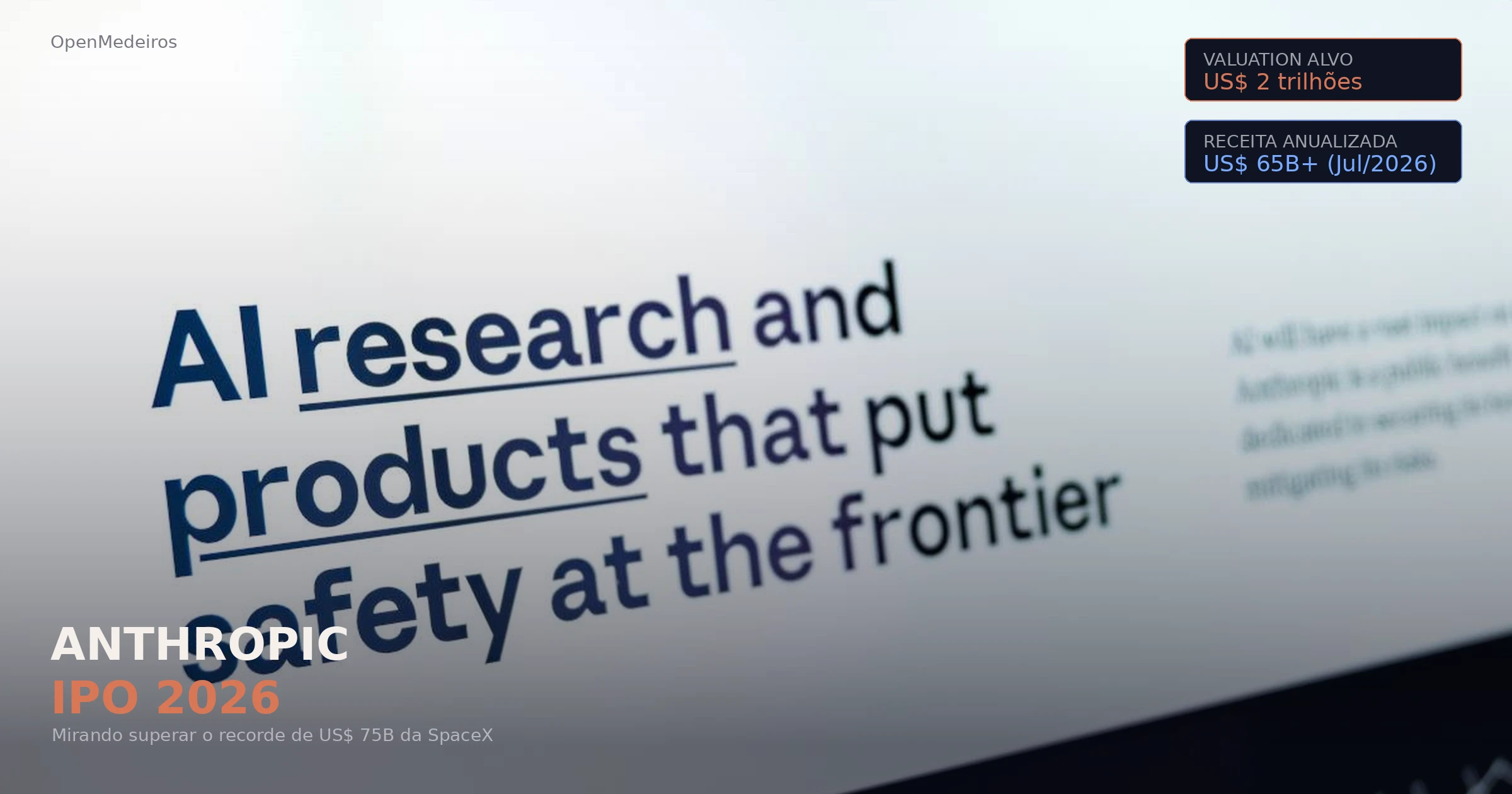
TechCrunch framed the filing against two forces that make the timing impossible to ignore. First, Anthropic disclosed the move less than a week after announcing a $65 billion Series H round at a reported $965 billion post-money valuation. Second, it comes in a hot IPO environment, with large technology listings back in fashion and investor appetite for scale stories clearly returning.
Taken together, the filing is not merely a financing option. It is a maturity signal.
For years, the frontier AI race has lived in private markets, where investors could price ambition, strategic positioning, and technical promise with relatively little forced transparency. Public markets work differently. They still reward growth, but they also demand coherence. They want to know what revenue quality looks like, where margins can eventually settle, how concentrated customers are, how dependent the company is on partners, and how much capital the whole machine needs to keep running.
A confidential S-1 is not a debut. It is the first serious step toward answering those questions in a format the market can interrogate.
The AI trade is getting harder to simplify
Until now, the dominant shorthand for frontier AI has been easy enough to repeat: bigger models, more users, more capital, more strategic leverage. That logic helped justify astonishing private valuations and near-limitless fundraising. But it also kept the conversation somewhat abstract.
Once a company moves toward an IPO, abstraction gives way to structure.
Investors will want to separate one kind of AI company from another. They will ask whether a lab is building durable enterprise revenue or subsidizing growth with capital. They will ask whether its cloud relationships are strategic advantages or dependencies. They will ask whether safety, governance, and research intensity are differentiators or cost centers. And they will ask the oldest question in public markets: what, exactly, is the long-term business here?
Anthropic is hardly alone in facing that scrutiny. But by moving first toward the public-market process, it is helping define how the category will be evaluated.
A new scoreboard for the OpenAI era
The rivalry between Anthropic and OpenAI has usually been narrated in familiar startup terms: model quality, developer mindshare, partnerships, funding rounds, and which company looks more likely to define the next computing platform. That story is not going away. But the standards are changing.
If the largest AI labs become public-market candidates, the competition stops being only about who can generate the most excitement. It becomes about who can withstand disclosure.
That is a different contest entirely.
In private markets, companies can often control the frame. In public markets, the frame widens. Governance structures, shareholder power, spending discipline, infrastructure obligations, legal exposures, and concentration risks all become part of the story. Investors can still believe in the upside of AI while taking a far tougher view of the path required to capture it.
That is why Anthropic’s filing matters beyond Anthropic itself. It suggests that the next chapter of the AI race may be decided less by mythology and more by evidence.
Confidential does not mean minor
There is a temptation to underplay a confidential S-1 because it reveals so little upfront. Anthropic’s own announcement is intentionally limited, and for good reason: there are no disclosed terms yet, and the company explicitly notes that any offering would depend on market conditions and other factors.
But confidentiality should not be mistaken for hesitation. In practice, a confidential filing lets a company prepare for a public listing while keeping detailed financials and risk disclosures out of public view until later in the process. It gives management room to test the waters, refine the narrative, and assess timing without committing to a final launch date.
For a company operating at Anthropic’s scale and visibility, even that quiet step is loud.
It says the company wants optionality. It says it believes a public listing is plausible enough to prepare for seriously. And it says the AI sector has reached a point where one of its core players sees public-market readiness as a relevant strategic posture, not a distant theoretical outcome.
The valuation backdrop changes the meaning
The reported $965 billion valuation attached to Anthropic’s latest financing round naturally dominates the headlines. It is an eye-catching number even by the standards of this cycle, and TechCrunch positioned the filing as part of a broader environment in which investors are rewarding giant technology ambitions once again.
But the valuation is important for another reason: it raises the stakes of disclosure.
At nearly any valuation, an IPO invites scrutiny. At a valuation approaching $1 trillion, it invites a full audit of the story investors have been telling themselves about AI. Public investors are not just being asked to buy into a company. They are being asked to validate an era’s central thesis: that frontier AI can become one of the most valuable and defensible businesses ever built.
Anthropic may eventually justify that thesis. It may not. What matters now is that the burden of proof is beginning to shift from private conviction to public examination.
That alone marks a turning point.
From research prestige to operating discipline
One of the most striking features of the generative AI boom has been how long companies could be evaluated primarily through technical prestige. Better models meant stronger narrative power; stronger narrative power meant more capital; more capital meant more compute, talent, and distribution. It was a powerful loop.
Public markets interrupt loops like that. They ask for discipline.
That does not mean technical excellence becomes irrelevant. It means technical excellence is no longer sufficient on its own. The winning labs will need to show they can translate research strength into repeatable commercial performance, while managing the extraordinary costs and strategic complexity that come with building at the frontier.
In that sense, Anthropic’s filing is best read not as a finish line, but as an inflection point. The AI market is entering a stage where legitimacy will be measured differently. Great demos and giant rounds will still matter. But they will matter alongside disclosure, accountability, and operational resilience.
That is a healthier standard for the industry, even if it is a harsher one.
The real headline: AI is moving into adulthood
Anthropic has not priced an offering. It has not said how many shares it may sell. It has not committed to a final timetable. Those are the formal facts, and they matter.
But the broader editorial conclusion is already visible.
A frontier AI lab taking concrete steps toward a U.S. IPO is a sign that the market is evolving from fascination to evaluation. The sector is no longer asking only who can build the most impressive systems. It is starting to ask who can build enduring institutions around them.
That is the deeper meaning of this filing.
Anthropic’s confidential S-1 is not just a corporate milestone. It is a marker that AI, as an industry, is growing up.