OpenAI’s planned acquisition of Ona is easy to misread if you look at it only through the usual AI lens. The headline mentions Codex, agents, and cloud infrastructure, so the reflex is to file it under “another capability expansion.” But the real significance is deeper.
This deal matters because it acknowledges a constraint the market has been dancing around for months: powerful agents do not become truly useful in production just because the underlying model gets better. They need a place to work.
And not just any place. They need persistent cloud environments, controlled credentials, reproducible setups, audit trails, policy enforcement, and clear boundaries around what they can touch.
That is what Ona brings to the table, and it explains why OpenAI wants it inside the Codex stack.
What OpenAI actually announced
On June 11, OpenAI said it plans to acquire Ona in order to bring the company’s secure cloud execution and orchestration technology into Codex. In OpenAI’s framing, the goal is straightforward: give Codex a persistent place to work for distributed teams.
The official announcement makes two points especially clear. First, Codex is already operating at meaningful scale. OpenAI says more than 5 million people now use Codex each week, up 400% from earlier this year. Second, the company sees the product moving beyond short, session-bound assistance. As Codex becomes more capable, OpenAI argues, its most valuable work increasingly unfolds over hours or even days rather than minutes.
That is the key strategic shift.
A coding or research agent that only works while a user keeps a laptop open is useful, but limited. A serious agent system should keep moving after the initial prompt: checking tools, reading context, making incremental progress, and returning results later. OpenAI is explicitly saying that this is where Codex is going.
Ona is meant to supply the missing substrate.
Why the acquisition is bigger than coding
OpenAI describes the deal as a way to support “long-running agents across software and knowledge work.” That phrasing matters. Codex may still be associated most strongly with software development, but OpenAI is clearly positioning it as a broader work engine.
Once that happens, the bottleneck changes.
The problem is no longer just whether the model can write code, summarize information, or plan tasks. The harder question becomes: where does the agent run, with what permissions, under whose control, and with what record of its activity?
That is where many AI product discussions still feel too shallow. The market often talks as if agent progress were mostly a function of better reasoning, better tool use, or better benchmarks. In practice, production adoption depends just as much on execution architecture.
An enterprise does not only ask whether an agent is capable. It asks whether the agent can operate inside existing security, governance, and operational requirements. If the answer is vague, the rollout stalls.
OpenAI’s own announcement effectively admits this. It says capable models are only one part of what organizations need as they move from experimentation to production workflows.
What Ona has built
Ona’s documentation and product pages help explain why OpenAI sees it as strategically useful.
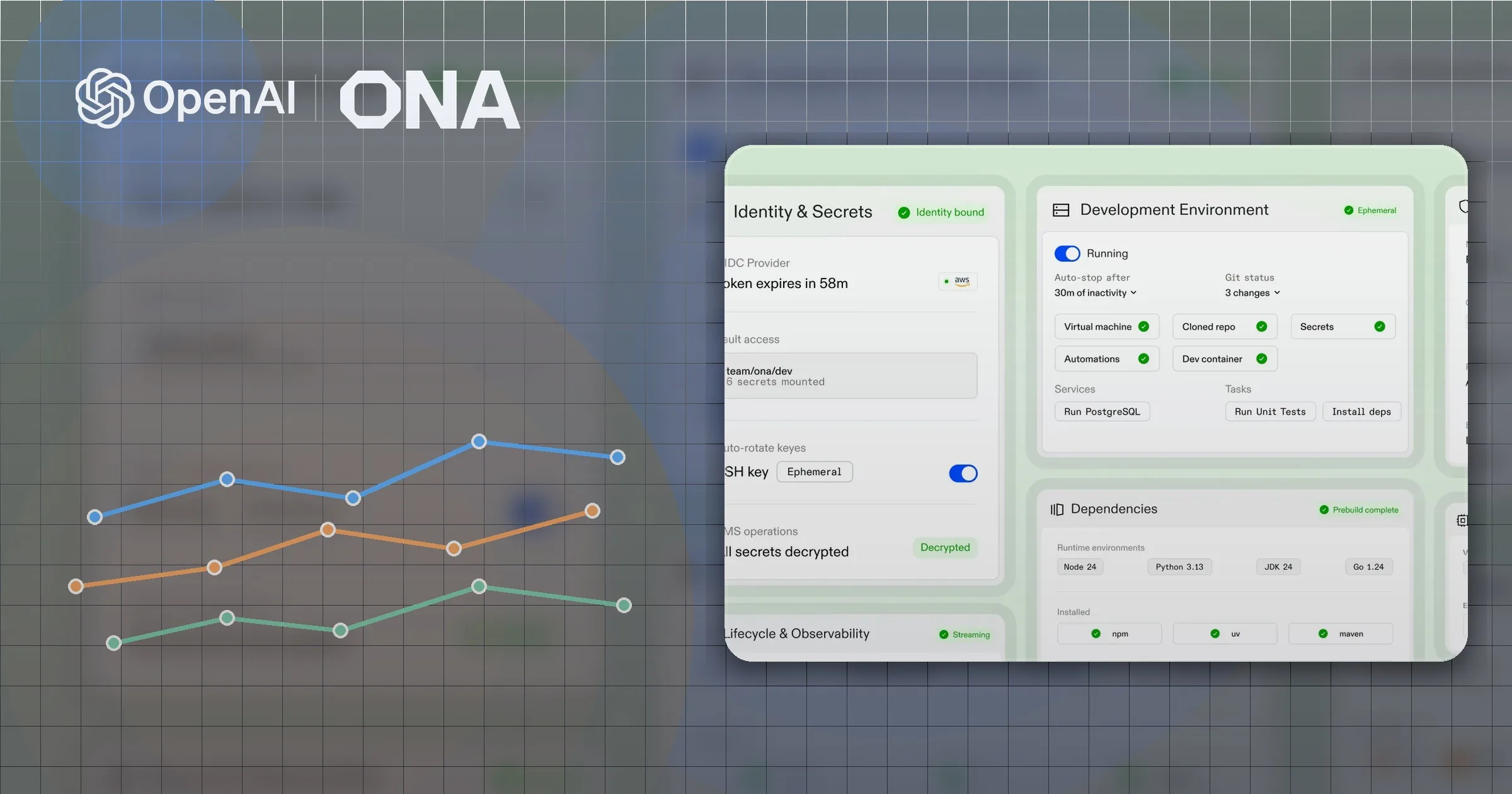
The company presents itself as “the platform for background agents.” Its documentation says teams can run AI software engineers in the cloud, either on Ona Cloud or in their own VPC on AWS or GCP, and can trigger agents through pull requests, schedules, or webhooks. The same materials emphasize reproducible environments, integrations with source control and editors, and governance features such as guardrails and audit controls.
Its homepage sharpens the positioning even more. Ona describes connected environments where each agent gets a full cloud workspace with tools, network access, and permissions. It highlights scoped credentials, audit trails, kernel-level policy enforcement, and the ability to run inside a customer’s VPC with complete network control.
That package is exactly what agent systems tend to lack when they are shipped first as consumer-style interfaces and only later pushed toward enterprise deployment.
The official OpenAI announcement adds another useful data point: Ona has helped 2 million developers work in secure, reproducible cloud environments. Whether one thinks of the company through its current agent framing or through its earlier cloud development environment roots, the through-line is the same. Ona specializes in moving work off the laptop and into controlled cloud execution.
That is why the fit with Codex is so direct.
The trusted workspace problem
The most important line in OpenAI’s announcement may be the simplest one: agents need a secure, persistent environment where they can access the tools, systems, and context required to make progress over time.
That cuts to the core weakness of many current agent products.
A lot of the industry is still operating with a chat-era mental model. The agent is treated as something that responds inside a conversation window, maybe with a few tools attached. But once the task becomes long-running or operationally sensitive, that model starts to break down.
Persistent work creates new requirements. State must survive beyond a single session. Credentials must be scoped. Activity must be observable. Review steps must exist. Infrastructure boundaries must be respected.
Without those layers, “agentic workflow” often means little more than a demo with extra steps.
This is where Ona changes the conversation. Its value is not just execution in the cloud. It is execution in the cloud under enterprise conditions.
Customer-controlled execution is the real signal
OpenAI says Ona’s customer-controlled execution model will allow agents to run inside an organization’s own cloud environment while OpenAI provides the intelligence and orchestration layer.
That is a much more important statement than it may look at first glance.
For many organizations, the biggest blocker to adopting advanced agents is not raw capability but control. They want to decide where workloads run, what systems agents can access, how credentials are issued, and how actions are logged. They want agent work to fit into existing review and compliance processes rather than bypass them.
This is especially important because the most valuable agent tasks are rarely the safest ones. The moment an agent becomes useful enough to touch repositories, internal tools, documentation systems, tickets, or production-adjacent workflows, governance stops being optional.
OpenAI is effectively conceding that the winning enterprise agent platform will not be the one that simply has the most capable model. It will be the one that combines capable models with trustworthy execution.
That is a more mature thesis than “smarter coding assistant.”
Why this could reshape Codex
CNBC reported that OpenAI did not disclose the terms of the acquisition and that the deal remains subject to customary closing conditions. The basic intent, however, is already clear: Codex is being prepared for longer-running work in cloud environments rather than only session-based assistance.
If OpenAI executes well, this could change what Codex is in practice.
Instead of acting mainly as an intelligent helper attached to a user’s machine, Codex can become a managed work layer that continues operating after the prompt, inside governed infrastructure, with the persistence needed for serious tasks.
The acquisition also suggests that the next phase of competition in AI agents will be fought below the model layer. Yes, reasoning quality still matters. But the more decisive battleground may be the execution substrate: persistent environments, orchestration, auditability, policy enforcement, and cloud control.
That is why this announcement deserves more attention than a typical acquisition note.
OpenAI is not just buying another feature. It is buying the conditions under which agents can be trusted to do real work.
Sources
- OpenAI: OpenAI to acquire Ona
- CNBC: OpenAI to acquire Ona to support its AI coding assistant, Codex
- Ona Documentation: Overview / Getting Started
- Ona: Run background agents