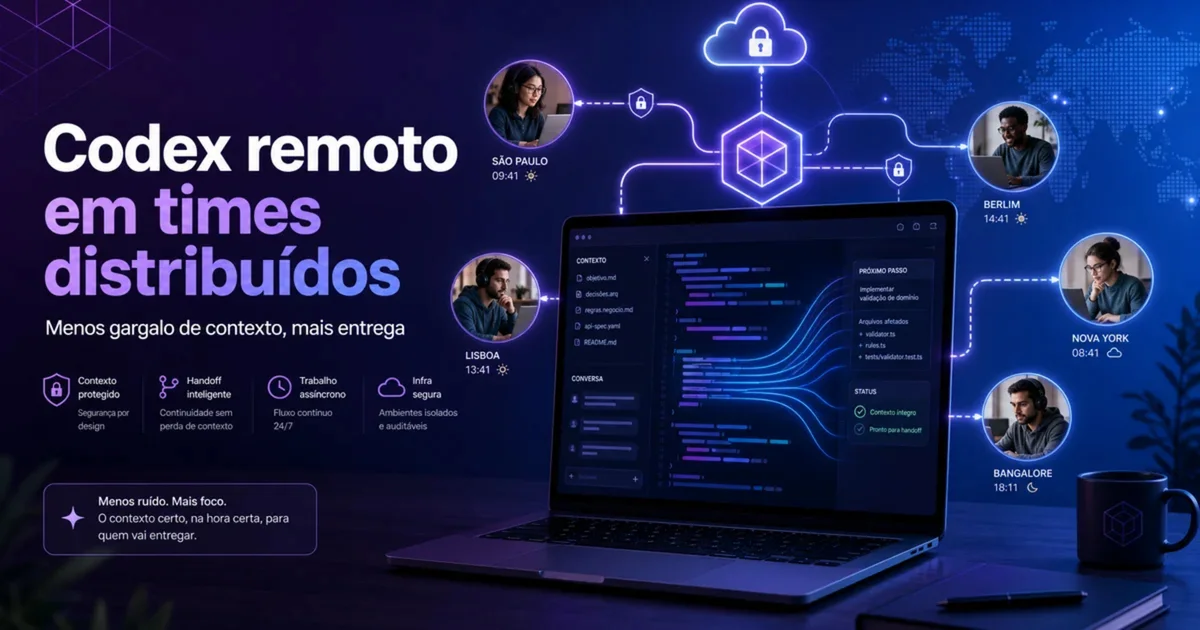
Remote engineering has always had a context problem. The code moves, but the reasoning behind the code often doesn’t move cleanly with it. That is why remote Codex matters more than it may look at first glance.
Over the past few weeks, it has become clearer that Codex is no longer tied to “my setup, my IDE, my environment”. The proposition now is broader: work from anywhere, keep context shared, and add stronger security around the workflow itself.
For distributed teams, that addresses an old and expensive pain point. Delivery slows down—or stalls completely—when critical context lives with just one person.
The real problem was never only writing code. The deeper problem was transfer. The person who started the task understood the decision path, the intent, and the constraints. The person who picked it up later had to rebuild that picture from scraps. In a remote team, that reconstruction happens all the time. At first it looks minor. By the end of the month, it becomes a real operational cost.
When remote workflow is done well, context stops being the property of one machine and starts acting like a team asset. That changes at least three things at once: handoff, review, and predictability.
Handoff stops feeling like a restart
The first gain is handoff.
A task no longer dies when someone steps away, ends the day, or switches priorities. The next developer can step in with history, state, and direction already visible. That cuts rework and reduces the classic remote-team problem of “I redid this because I couldn’t understand what was already happening.”
This matters because handoff friction is rarely just a documentation problem. Tickets may describe what needs to be done, but they usually fail to capture the reasoning that shaped the path so far. When that reasoning becomes easier to carry forward, work does not need to restart from zero every time ownership changes.
For distributed teams working across time zones, that continuity has a direct effect on throughput. Less context rebuilding means more actual progress.
Review gets more objective
The second gain is review.
When context is easier to access, code review stops being a scavenger hunt for missing details and becomes a discussion about technical judgment. That is a meaningful upgrade.
A lot of pull requests take too long not because the code is unusually complex, but because reviewers need to infer intent from fragments: commit history, comments, half-explained tradeoffs, and implementation clues. That makes feedback slower and more subjective than it should be.
With better continuity, review gets more precise. Reviewers spend less time asking what happened and more time asking whether the decision was the right one. PR cycle time falls not because standards drop, but because the conversation becomes clearer.
Planning depends less on heroes
The third gain is predictability.
Many remote engineering teams still rely too heavily on informal specialists: the person who knows the awkward edge case, the old workaround, or the exact reason a fragile service was left untouched. Planning then depends on availability, not resilience.
Shared context helps break that pattern. It does not erase expertise, and it does not make everyone interchangeable. What it does is make the team less fragile. Sprint planning becomes more stable when execution does not depend on one person carrying the whole narrative of the work in their head.
That is where remote workflow starts to look less like convenience and more like operational infrastructure.
Better context does not replace process
None of this means teams can relax their process. If context moves faster, mistakes can move faster too.
The upside only holds when the team pairs the workflow with a few simple, consistent rules: branch conventions, a clear definition of done, review checklists, and clean decision logs. The goal is not bureaucracy. The goal is to keep the system easy to follow when work is moving quickly.
That distinction matters. Shared context without guardrails can spread confusion just as efficiently as it spreads clarity.
A practical way to test it
The wrong move is trying to redesign everything at once.
A better starting point is a two-week test with one critical workflow. Pick a flow where context loss already hurts—something with frequent handoffs, review friction, or coordination across time zones.
Then measure two things before and after: handoff time and review time. Those metrics are simple enough to track and concrete enough to show whether the process is actually improving.
After that, document the friction points. The idea is not to blame the tool when something feels awkward. The point is to see what in the process needs adjustment so the team can capture the gain without creating new confusion.
Why this matters more than feature hype
This is the central point.
Remote engineering has always suffered from context loss. If Codex genuinely reduces that loss with more continuity and stronger security, then it is not just another AI feature added to the stack.
It starts to become productivity infrastructure.
That is a more important shift than it sounds. Engineering teams do not win just by generating code faster. They win when they can move decisions, intent, and constraints across people without losing the thread.
Distributed teams do not need magic. They need context that stays alive—shared, accessible, and auditable. Once that becomes part of the workflow, speed shows up as a consequence instead of a constant struggle.