OpenAI confirmed this week what had been taking shape since June: ChatGPT will display ads in 31 European countries starting August 24. It’s the largest expansion of the company’s advertising business so far — and it arrives with a set of rules that tries to reconcile monetization with GDPR.
Who sees ads, who doesn’t
Ads appear exclusively for users on the Free tier and the Go plan (€7.99/month). Plus, Pro, Enterprise, Business, and Education remain ad-free. OpenAI’s argument: advertising funds free and low-cost access to ChatGPT.
There is an ad-free variant of the Free plan, but with reduced limits — fewer messages per day and no access to tools like image generation or deep research. That stripped-down version is exactly what could trigger regulatory scrutiny.
Contextual first, personalized later
At launch, ads are explicitly contextual. Selection draws on the current conversation topic, approximate location, device type, time of day, and language. Past chats and stored memories are not in the equation — yet.
Personalization comes in a second step, and only after users actively consent. Those who opt in will see ads that also draw on the current chat thread (including personalized model responses), past chats, memories, and interactions with previous ads. Controls sit under Settings > Ad controls, where ad data can be deleted — a process that can take up to 30 days.
The legal basis for contextual ads is legitimate interest under GDPR. For personalized ads, OpenAI is betting on explicit consent — which puts it in a different position from companies that clashed with the EU and were eventually forced to change their approach.
How advertisers access the platform
There’s no self-service at launch. Bookings run through the OpenAI Ads Solutions team, agency partners, and technology partners. Self-service access via the Ads Manager is set to follow later this summer.
The platform already supports CPM, CPC, conversion optimization, geo-targeting, and custom audiences. Measurement includes the OpenAI Pixel, a Conversions API, and third-party integrations. Tens of thousands of marketers have advertised on ChatGPT so far, according to the company.
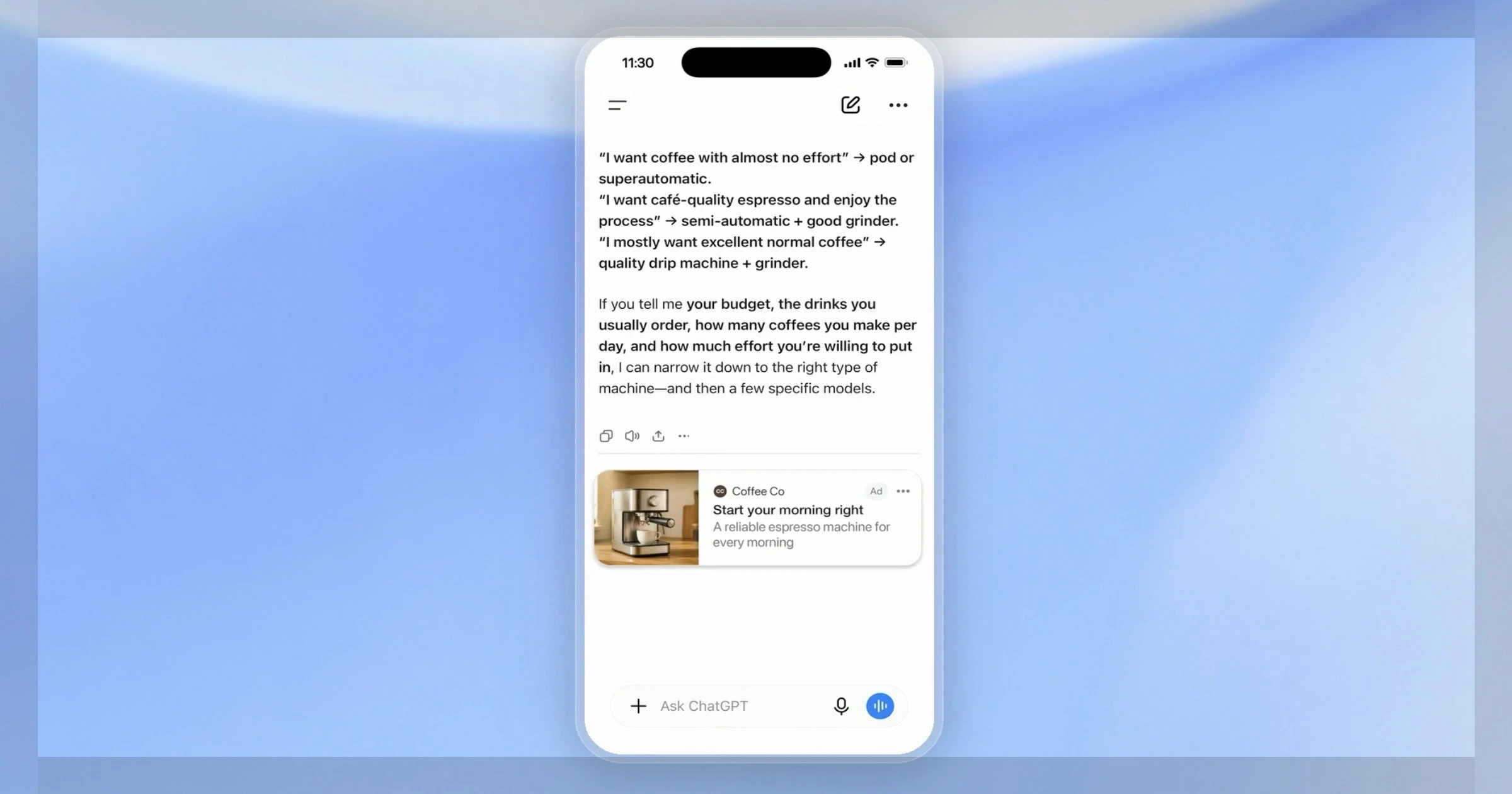
Ads appear below the model’s response, labeled as “sponsored” and visually separated. OpenAI states that advertising does not influence the model’s answers. Advertisers receive only aggregate metrics — views and clicks — with no access to chats, memories, names, emails, IP addresses, or precise locations.
The debate that won’t go away
The critical point is the ad-free Free plan with reduced limits. In 2024, the European Data Protection Board published Opinion 08/2024 on “consent or pay” models, determining that platforms must offer a genuine, equivalent alternative without behavioral advertising.
If the stripped-down Free tier doesn’t meet that standard, OpenAI could face regulatory action. The controller for processing personal data in the EEA and Switzerland is OpenAI Ireland Limited, based in Dublin — making the Irish Data Protection Commission the competent supervisory authority. Processing takes place on servers outside the EEA, in the United States, relying on adequacy decisions and standard contractual clauses.
This framing matters because it shows OpenAI learned from the hard path Meta walked. Instead of insisting on legitimate interest for everything and being forced to retreat, it’s asking for consent up front for personalization. The question is whether the ad-free Free tier is “equivalent” enough to satisfy regulators.
What changes for developers
For devs using the API: nothing. Ads are exclusive to the chatbot interface. The API doesn’t receive ads, doesn’t change pricing because of them, and isn’t affected by the advertising layer.
For those evaluating model routing, the ads expansion signals that OpenAI is diversifying revenue beyond subscriptions — something that shifts the competitive equation when compared to Anthropic and Google, which still don’t run ads in their chatbots.
A market with more competitors ad-free than not
For now, the AI chatbot market has more companies without ads than with. Perplexity, Anthropic (Claude), and Google (Gemini) keep their products ad-free. OpenAI is the first frontier lab to bet on ads as a revenue line — a move that could pressure competitors if it works, or become a case study on the limits of consent-or-pay if it stumbles on GDPR.
The August 24 launch covers Germany, France, Spain, Italy, Sweden, Norway, Denmark, the Netherlands, Austria, and 22 other markets. In the US, where ads started in February, advertiser reception has been moderate — not a runaway success, but not a stall either.
Text produced with assistance from Javi, my AI agent. Curated by me — Rhuan Medeiros.