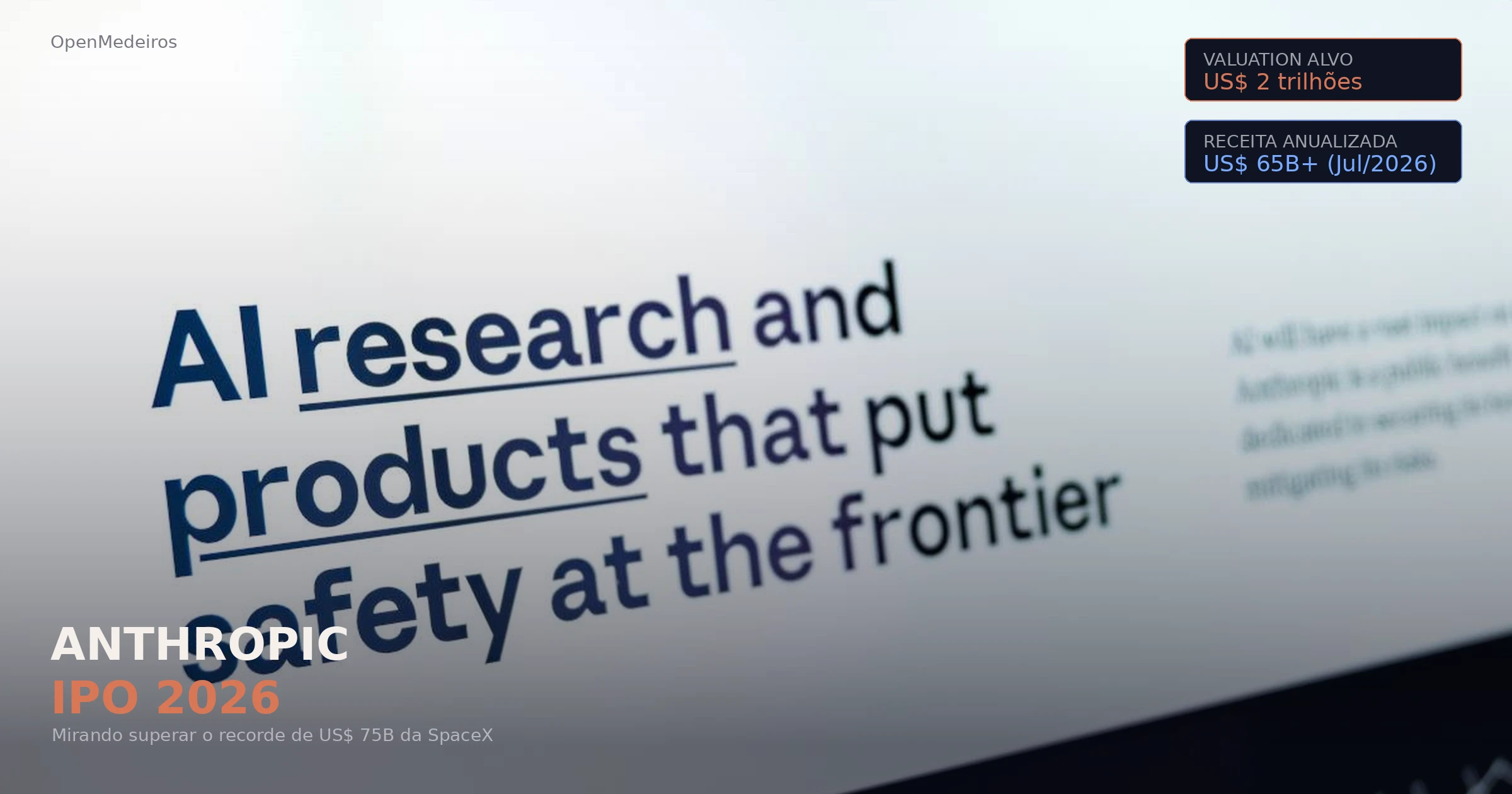
Anthropic told prospective investors that its Q2 2026 revenue exceeded $11.5 billion — a 14-fold jump from the $787 million it brought in during the same quarter of 2025, and more than double the $4.73 billion reported in Q1. Alongside that growth, the company reported positive adjusted operating income, making it the first frontier AI lab to prove that the AI business model can generate profit.
The numbers, seen by Bloomberg News in documents shared with investors, are preliminary and subject to revision. But the message is already clear: the thesis that AI only burns money just lost its best counterexample.
The engine behind the number
The growth didn’t come from consumer flash. Approximately 85% of Anthropic’s revenue comes from enterprise and developer customers, with over 500 companies spending more than $1 million annually on the Claude platform. Eight of the Fortune 10 are customers.
The operational standout is Claude Code, which surpassed $1 billion in annualized revenue in less than six months since launch. It’s the product that most clearly translates Anthropic’s thesis: AI as development infrastructure, not as a chat toy.
This matters because enterprise customers generate three to five times more revenue per token than consumers, their query patterns are more deterministic (cheaper to serve), and their contracts are sticky. That’s the foundation of a profitable business — not a free-tier base of 900 million users generating massive inference costs without proportional revenue.
OpenAI and Anthropic: opposite paths
The comparison with OpenAI is inevitable and illuminating. OpenAI projects a $14 billion loss in 2026 and doesn’t expect to reach profitability before 2029 or 2030. Its revenue is predominantly tied to ChatGPT consumer subscriptions, with roughly 95% of users paying nothing. Computing expenditure will reach $121 billion in 2028 alone.
Anthropic, by contrast, projects $17 billion in positive cash flow in 2028, with gross margins approaching 77% — numbers closer to enterprise software than to AI infrastructure.
If you want to understand how model routing affects cost and margin in production, our analysis of AI model routing and cost is worth reading. The decision of which model to use for each task is exactly where enterprise economics diverges from free consumption.
What changes for people using Claude at work
For developers and teams relying on the Claude API, the news carries a practical meaning: the company behind the tool has its own financial runway. It doesn’t need the next funding round to keep the model running, to invest in capacity, or to improve the product.
This reduces platform risk. If you’re building agent pipelines with Claude, the vendor just demonstrated it can sustain operations with revenue — not just investor capital. For a deeper discussion on evaluating this tradeoff, our review of Claude Opus 5 and automatic fallback covers exactly the questions a developer should ask before committing to a model.
IPO: the public market test
Anthropic has filed confidentially for an IPO and is working with Morgan Stanley, Goldman Sachs, and JPMorgan Chase. CFO Krishna Rao is leading initial meetings with investors. The latest funding round in May valued the company at $965 billion.
The question markets will need to answer is straightforward: how much is an AI company that already profits worth? Anthropic arrives at its IPO with something OpenAI still lacks — a profitable quarter, not a promise of future profit.
The caveats behind the adjustment
It’s worth noting what the number doesn’t include. The adjusted operating income excludes stock-based compensation, which at a company that has raised over $130 billion could be large enough to erase the margin on a GAAP basis. Anthropic may also not stay profitable for the full year, given planned increases in compute and model training spending.
The figures are preliminary. Bloomberg emphasizes they could be revised. An Anthropic representative declined to comment.
Why this matters beyond finance
The fact that a frontier AI lab has achieved operating profitability changes the calculus for the entire sector. Investors can now model a path to returns rather than funding indefinite losses. For enterprise buyers and technical leaders, it signals that Anthropic has enough commercial momentum to sustain long-term model development and API reliability without depending on the next funding round.
The AI race always had two open questions: does the technology work, and does the business work. The first was answered some time ago. The second just received its first positive answer.
Sources:
- Bloomberg via CNBC — Anthropic revenue jumps to over $11.5 billion in Q2
- Forbes — OpenAI And Anthropic Are Testing Two Very Different AI Business Models
- Bloomberg via Yahoo Finance — Anthropic Revenue Surges to Over $11.5 Billion
Text produced with assistance from Javi, my AI agent. Curated by me — Rhuan Medeiros.