Bloomberg confirmed this week that Anthropic expects to match or beat SpaceX’s record IPO — the largest initial public offering in history. If it happens, the deal doesn’t just rewrite IPO rankings. It rebalances the power structure of the AI industry.
The record Anthropic wants to break
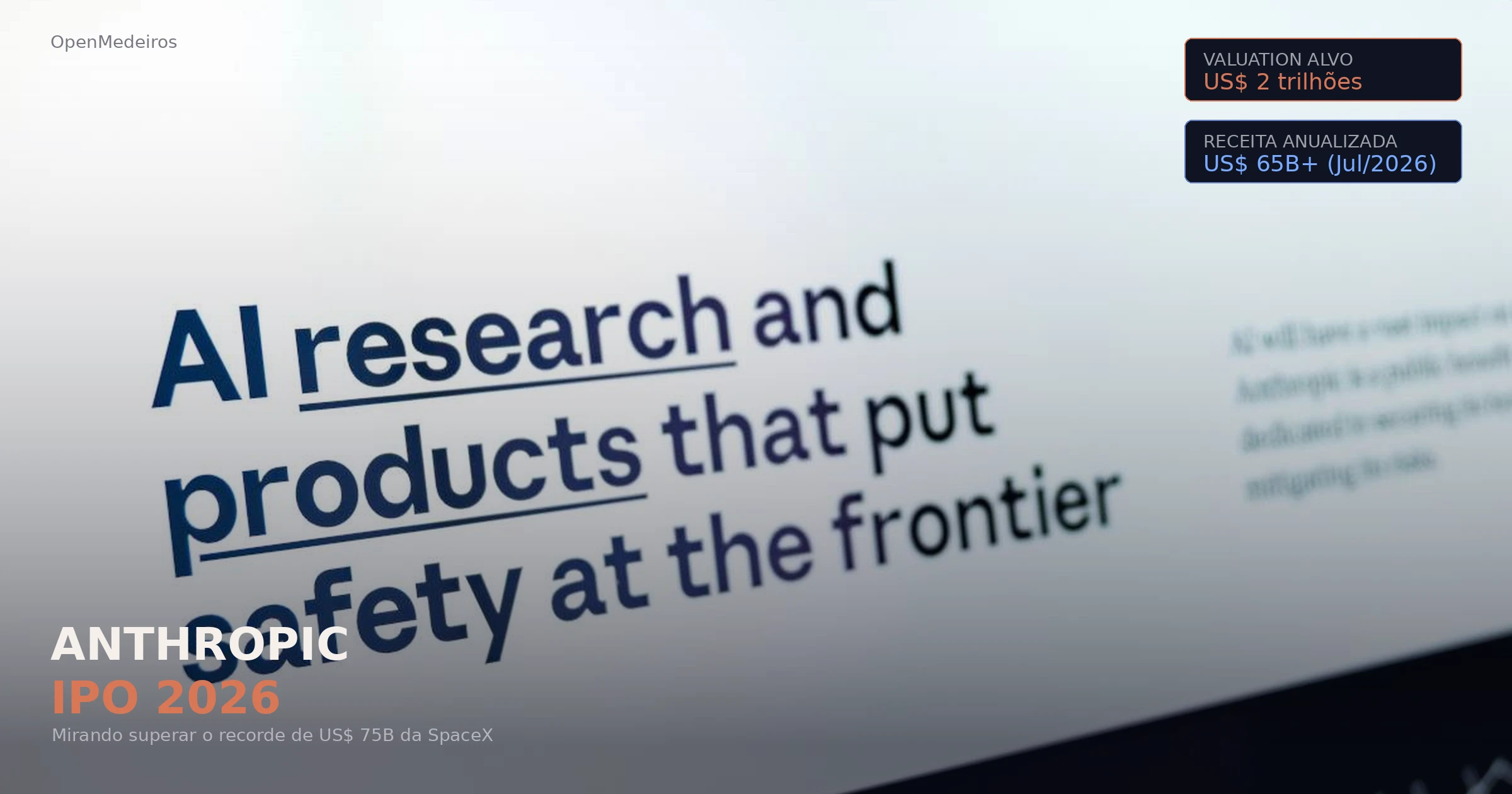
SpaceX raised $75 billion in June 2026, pricing 555.6 million shares at $135 each. With the overallotment option exercised, the total reached $86.2 billion. It was the biggest IPO of all time, more than double Saudi Aramco’s previous record.
Now, sources familiar with the matter tell Bloomberg that Anthropic wants to match or exceed that figure. CFO Krishna Rao has been leading investor briefings, though the company has not yet locked in a valuation.
From $965 billion to potentially $3 trillion
Anthropic was valued at $965 billion after its Series H in May, when it raised $65 billion — surpassing OpenAI’s valuation of $852 billion from March. Investors speaking to the Financial Times now expect an IPO valuation between $2 trillion and $3 trillion, more than double the initial target of $1 trillion.
That expectation rests on a revenue trajectory that’s startling in its velocity. Preliminary Q2 2026 revenue exceeded $11.5 billion, compared to $787 million in the same period of 2025 — a 14x jump. The annualized run rate surpassed $65 billion in July, and investors project $100 to $120 billion by December.
This means that even at the low end of expectations ($2 trillion with $100 billion in annualized revenue), the IPO would price Anthropic at 20x projected revenue. At the high end ($3 trillion with $65 billion), that’s 46x — a multiple few companies in history have sustained.
Behind the scenes
Anthropic has already confidentially filed its S-1. According to sources, the company could file publicly as soon as the end of August and is finalizing a revolving credit facility expected to exceed $10 billion.
Anthropic is also ahead of OpenAI on the timeline: while Anthropic targets October, OpenAI has slid to 2027, per Bloomberg. Both companies have filed confidential registrations.
Investors have poured nearly $100 billion into Anthropic in 2026 alone. In April, Amazon announced $25 billion in investment, with Anthropic committing roughly $100 billion to AWS services. In July, AMD contributed $5 billion and provided access to 2GW of latest-generation chips.
Why revenue grew so fast
Anthropic doesn’t share official user figures, but Statista estimated about 245 million monthly Claude users in June. For comparison, ChatGPT reached 1 billion users in May.
Where Anthropic differentiates is enterprise. A March analysis by Axios found the company was capturing more than 73% of first-time enterprise AI customers, versus 26% for OpenAI. That dominance of the most lucrative segment explains why investors accept such high valuations despite historical losses.
The company posted a net loss of $42 billion in 2025, nearly a fivefold increase from about $8.3 billion the year before. But Q2 2026 brought the first positive adjusted operating income, and SemiAnalysis analysts project GAAP EBIT above $1 billion in Q3.
What changes for developers and enterprises
In the short term, nothing. The IPO doesn’t alter API pricing, Claude features, or the product roadmap. But there are three things to watch in the medium term.
First, revenue pressure. A public company must deliver quarterly growth. That could accelerate changes in API pricing, enterprise plans, and feature monetization — something we’ve already seen with Claude Opus 5 and its automatic fallbacks, where cost optimization became a competitive differentiator.
Second, transparency. As a public company, Anthropic will have to disclose financial metrics quarterly. That means real visibility into revenue, margins, and compute investment — information that currently circulates only in private briefings. For anyone evaluating which AI model is worth running in production, this helps predict pricing trajectories.
Third, a company that just posted its first operating profit and now seeks $2 trillion in valuation is clearly betting that the AI frontier keeps expanding fast enough to justify the multiple. If revenue decelerates, the market will punish it.
The 2026 IPO boom in context
Through August 19, IPOs had already raised $160.6 billion in 2026, according to Bloomberg data. SpaceX alone accounted for nearly half that volume. An Anthropic IPO in the $75 to $90 billion range would not only cement 2026 as the best year on record for US public offerings, but also place AI at the center of capital markets in a way no other industry has managed.
What’s at stake isn’t just money. It’s the answer to a question the market hasn’t publicly asked yet: can a five-year-old AI company with $42 billion in cumulative losses and revenue growing 14x year-over-year be worth $2 trillion? The institutional investors who buy that thesis will be betting the growth continues. The developers and enterprises who depend on Claude will be extending that same bet — whether they realize it or not.