RAG has always promised a lot. In practice, much of the work has turned into damage control engineering: extract text from PDFs, handle images separately, preserve context, build an index, and hope the answer cites the right source.
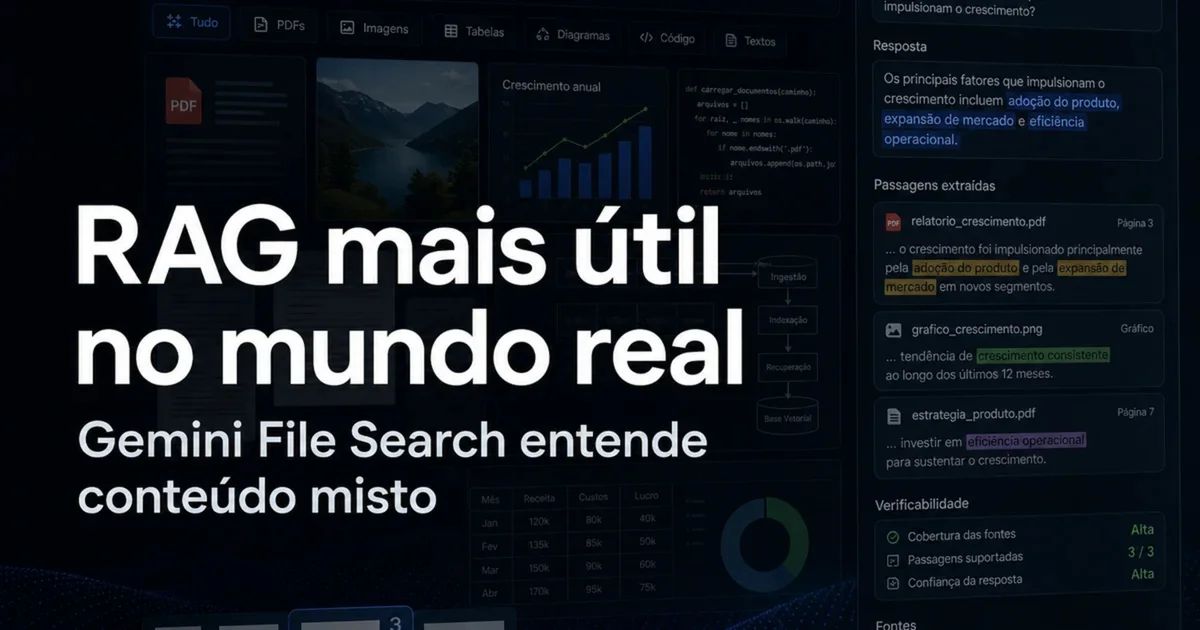
Gemini API File Search has now taken a step that matters less for demos and more for real operations: it is multimodal, supports custom metadata, and can return page-level citations.
This is not a magical revolution. But it is a concrete improvement at exactly the point where many teams get stuck when they try to search real documents full of images, tables, messy layouts, and scattered context.
What actually changed
Google announced three main updates to Gemini API File Search.
The first is multimodal support. In practice, search can now process images and text together in the same flow. That matters because many useful documents are not just plain text. They are PDFs with charts, screenshots, diagrams, scanned forms, slide decks, technical manuals, and reports whose visual elements carry part of the meaning.
The second is custom metadata. You can now attach key-value labels to files and use them as retrieval filters. That may sound like a detail, but it can sharply reduce noise in a large internal corpus. Instead of asking embeddings alone to decide what is relevant, teams can impose operational context: business unit, region, product, version, classification, date, language, or regulatory status.
The third is page-level citation. For any serious use case, this may be the most important change. The system can point to the page where a retrieved passage came from. In RAG, that improves grounding, transparency, and auditability. Put simply, it becomes easier to verify that an answer is anchored in something real.
Why this matters more in the real world than on benchmarks
Anyone working with internal document bases knows where the theory usually breaks down. The problem is rarely just finding a similar passage. The problem is finding the right passage inside an imperfect document, where signals are split across text, images, and layout.
A support manual may contain a screenshot that is more useful than the paragraph next to it. A regulatory PDF may place the key rule inside a table. An internal playbook may depend on the difference between near-identical versions. When the pipeline flattens everything into text, that loss of context turns into operational error.
File Search already handled the expected basics: import files, chunk them, index the data, and retrieve relevant passages for RAG. The step forward is that this flow is now less blind to mixed-content documents and easier to govern at retrieval time.
That does not remove the need for architecture. But it does reduce the amount of manual patchwork required to make search feel even minimally reliable.
Less handcrafted pipeline work
Many teams that put RAG into production ended up building a parallel pipeline for every file type: OCR on one side, PDF parsing on another, image extraction in yet another step, then normalization, external tagging, reindexing, and a lot of glue between services.
That kind of pipeline costs time, creates maintenance burden, and fails silently. And when it fails, the end user usually pays for it in the form of a confident but wrong answer.
When the search layer already understands multimodal content, the gain is not only technical. It is operational. Fewer components to orchestrate. Less context lost in conversion. Less chance of breaking at the edges. And more speed when shipping a use case that works without feeling like an eternal prototype.
That does not mean the problem is solved. Bad PDFs still exist. Scanned documents are still scanned documents. But the focus changes: instead of spending energy just to make data searchable, teams can spend it on what matters more—access policy, corpus quality, evaluation, and decision flow.
Support, compliance, and internal knowledge are the obvious use cases
This kind of improvement makes the most sense in three areas.
In support, because the knowledge base is rarely clean. There are internal articles, system screenshots, changelogs, FAQs, and technical documentation across different versions. Metadata helps filter by product, release, or channel. Multimodality helps when the answer depends on an interface element or a diagram. And page-level citation helps analysts trust what was retrieved.
In compliance, because an answer without a source trail is almost useless. It is not enough to say that a policy allows something. You need to show where that came from, in which document, and on which page. Page-level citation does not solve governance by itself, but it changes the conversation between automation and audit.
In internal knowledge bases, because noise is the main enemy. Companies accumulate redundant, outdated, conflicting, and poorly labeled documents. Custom metadata works as a brake. Instead of throwing all that entropy into a vector index and hoping for a miracle, teams can filter first: only documents from one department, one country, one valid version, or one specific time period.
That kind of adjustment may look minor from the outside, but in practice it can significantly change retrieval accuracy.
The central issue is verifiability
RAG hype has long sold the idea of hallucination reduction. The problem is that the phrase became too loose. Without a clear source, a precise excerpt, and context control, the system may answer better than a standalone model, but it is still hard to audit.
That is where page-level citation carries real weight. It is not just a UX flourish. It moves the product closer to an actual workflow in which someone needs to check, justify, or approve an answer. In regulated areas, that is a requirement, not a luxury. In internal support, it is what keeps the bot from becoming just another channel nobody takes seriously.
Useful RAG is not the one that sounds polished. It is the one that makes verification fast.
What is still not worth romanticizing
It is also worth cooling the temperature a bit. Multimodal search does not mean perfect understanding of every messy document. Good metadata still depends on disciplined cataloging. And page-level citation is excellent, but it does not replace continuous evaluation of relevance, coverage, and source conflicts.
On top of that, no retrieval system solves the problem of outdated documents by itself. If the corpus is bad, the answer will be elegantly bad.
So the gain here is not that RAG finally works. The gain is narrower and more honest: it is now easier to build verifiable RAG, with less manual effort, for scenarios where real-world documents matter more than pretty benchmarks.
Conclusion
The real advance in Gemini File Search is not that it feels futuristic. It is that it addresses three concrete pain points at once: understanding mixed content, filtering the search space more effectively, and showing more precisely where an answer came from.
That moves RAG toward a less theatrical and more operational kind of use. Support, compliance, and internal knowledge bases are likely to feel that impact first—not because they are flashy, but because they suffer most from ugly documents, confusing context, and traceability requirements.
In the end, the best news may be this: the value here is not in promising general intelligence over files. It is in reducing friction where there used to be too much pipeline and too little verifiability.