When a company says a model got faster, the easy reaction is to file it under infrastructure trivia. Google’s new Gemini Nano update for Pixel deserves more attention than that. In its technical write-up from Google Research, the company says Pixel 9 devices saw speedups of 50% or more versus standalone drafters with comparable parameter counts. Google did not swap in a new backbone. It changed the generation path.
That matters because a large share of on-device AI cost lives in the runtime, not only in the model card. A useful local model has to answer quickly, stay inside tight RAM limits, avoid waking heavier processors more than necessary, and keep battery drain under control. This is the same family of constraints that showed up in Gemma 4 becoming up to 3x faster at the edge. The difference here is that Google is not talking about a new open model for developers. It is improving a model that already ships inside consumer phones.
Google’s term for the change is frozen Multi-Token Prediction, or frozen MTP. The frozen part is the point. Gemini Nano v3 stays in place as the main model. Google freezes the backbone weights, attaches a lightweight Transformer head to the final layers, and trains only that added head to predict future tokens more efficiently. Instead of running a separate drafter model with its own memory burden and limited visibility into what the main model already knows, the MTP head works directly from the backbone’s internal activations.
This did not appear out of nowhere. Google frames the work as part of the broader speculative decoding line, and explicitly connects it to earlier ideas such as Confident Adaptive Language Modeling, or CALM. It also follows the company’s more recent push around multi-token prediction for Gemma 4. What changes on Pixel is the environment. In the cloud you can buy headroom with more hardware, batching, and bandwidth. On a phone, every millisecond and every megabyte count harder.
What Google says it shipped on Pixel
According to Google, the approach has already been rolled out to the Pixel 9 and Pixel 10 line as an out-of-the-box speedup. The post points to production features such as AI Notification Summaries and Proofread. In real workloads, Google says MTP predicts nearly two additional tokens per inference pass on average. That may sound small. It is not.
Autoregressive models live on repetition. One token at a time, one verification step at a time, one burst of work at a time. If more candidate tokens can be accepted in a single pass, the system needs fewer verification cycles. Google ties that directly to less time waking heavier processors, lower energy use, and better battery life. The company also says the design saves up to 130 MB per instance compared with a standalone drafter, largely because it reuses the backbone’s existing cache and avoids duplicate context handling.
This is the sort of improvement that rarely becomes a mainstream headline, but often changes product decisions. On a phone, latency is not just a quality-of-life metric. It decides whether a feature can stay local by default, whether it needs more fallbacks to the cloud, or whether it becomes too sluggish to feel worth keeping on.
Why frozen MTP is more interesting than it sounds
There is a strategic reason this approach matters. Replacing a base model to gain efficiency tends to move too many variables at once. Behavior changes. Safety evaluation has to be revisited. Product teams worry about regressions. Compatibility work reopens. Rollout risk goes up. When the backbone stays frozen, the conversation changes. The gain is framed as an inference optimization rather than a new model identity.
Google leans into that distinction. The post says a frozen backbone makes MTP a strict efficiency optimization, with no degradation in the model’s existing capabilities or safety alignment. That is a meaningful claim for teams that already have features in the field. In many shipping environments, the biggest fear is not losing benchmark points. It is breaking a user-facing flow and triggering another round of validation work no one wants.
It also helps explain why local models still matter even while the industry narrative keeps drifting toward agents and cloud platforms. I made a similar case in why Gemma 4 12B still makes sense for local multimodal use. Privacy, predictable cost, and immediate response still have real value. This Pixel update reinforces that point. The problem was never that on-device AI lacked purpose. The problem was the friction involved in making it feel good enough to use every day.
What this changes for product teams
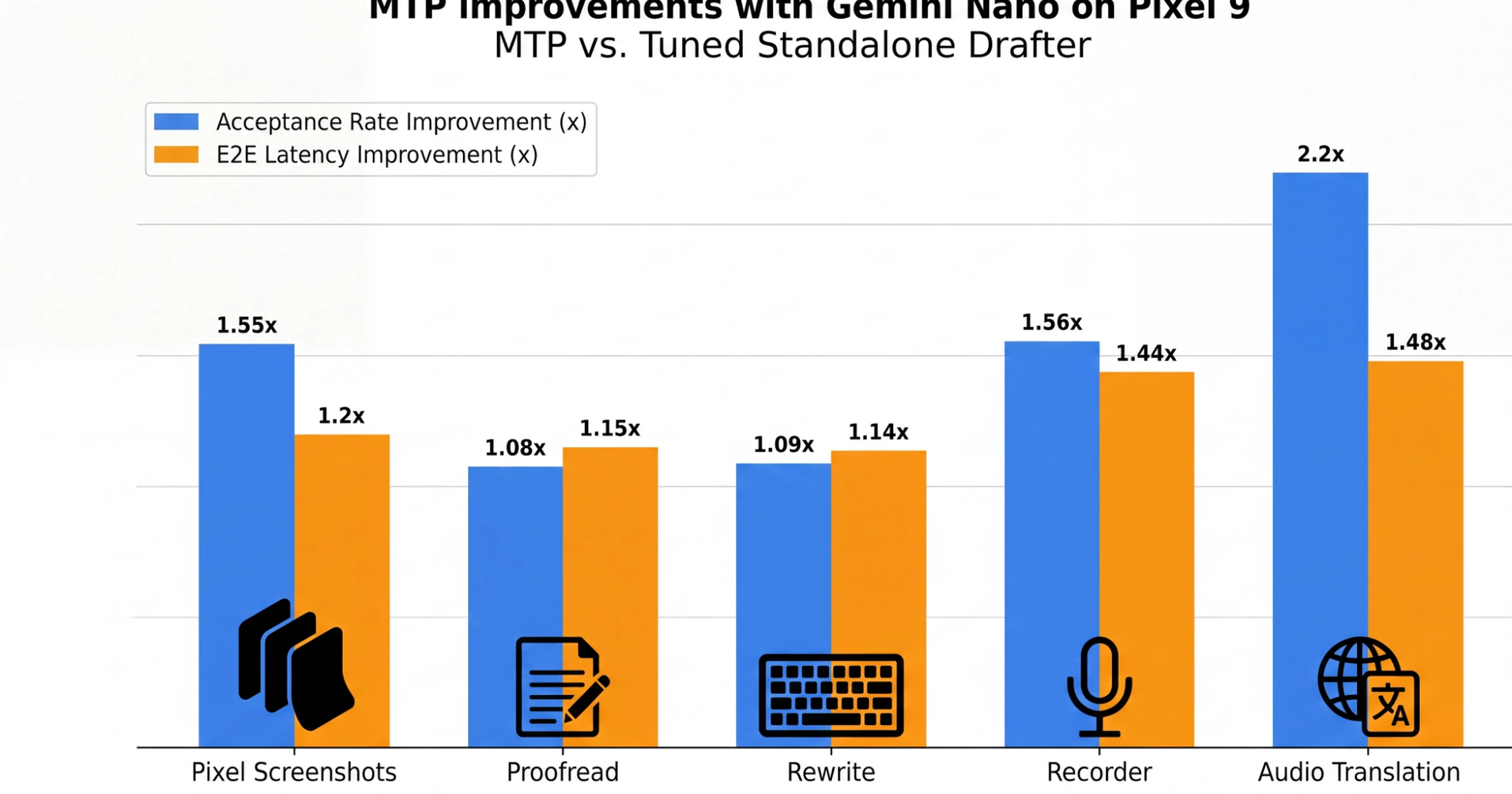
If you build AI features for phones, the good news is not only that one bar chart went up. The better news is that Google is outlining a path to improve several kinds of workloads without training a separate drafter for every feature. The post highlights gains across Pixel Screenshots, Proofread, Rewrite, Recorder, and Audio Translation. Some workloads benefit more than others, but the underlying idea is consistent: reduce overhead by drafting from the main model’s own internal state instead of bolting on another small model that has to duplicate context.
That changes engineering cost. A stack full of task-specific helper models becomes expensive fast. Every use case turns into a custom exception. Every model revision invites another tuning cycle. Every extra component creates more memory pressure. Once the drafter can reuse the backbone’s hidden states and key-value cache, that overhead starts to shrink.
There is also a product consequence that goes beyond speed. The more reliable local inference becomes, the easier it is to justify experiences that do not depend on a server round-trip. That affects privacy, offline resilience, and recurring cost. At the same time Google is pushing cloud-side orchestration with Managed Agents in the Gemini API, it is also working on the opposite end of the stack, where the user’s phone handles what should feel immediate and private.
That is why I do not read this as an edge-versus-cloud story. It looks more like a cleaner division of labor. The cloud handles the work that needs tools, long context, and heavier execution. The device handles the interactions that benefit from speed, privacy, and high-frequency use.
What remains unclear
Google’s post is persuasive on the technical direction, but it still leaves open questions. The first is coverage. Gains vary by workload. Pixel Screenshots, Recorder, and Audio Translation look especially strong. Proofread and Rewrite improve less in end-to-end latency. That does not weaken the main point. It simply shows that structure and predictability still matter.
The second question is ecosystem reach. Pixel is Google’s best place to prove the concept, but the bigger market story starts when techniques like this spread beyond one flagship line, or at least shape broader Android and edge inference tooling. Google closes by pointing to future work such as parallel decoding and approaches without auxiliary heads. That sounds less like a finished chapter and more like an active roadmap.
The third question is product judgment. Better efficiency is necessary, but it does not automatically make a feature good. Local AI still needs sensible triggers, clear boundaries, and disciplined integration into the app surface. A faster model does not rescue a bad product decision.
The more important signal
For me, the real point is not the 50% number itself. It is the message behind it. Google is treating mobile inference as a product architecture problem in its own right, not as a watered-down copy of server-side AI. Instead of pushing every improvement through a bigger or newer model, it is improving the execution path of a model that users already have.
That kind of work attracts less hype than a flagship model launch. It usually has a better chance of changing day-to-day experience. When an improvement reduces latency, memory pressure, and energy use at the same time, it can move a feature from demo-friendly to habit-friendly.
That is the line that separates AI that sits on a spec sheet from AI that becomes normal behavior on a phone. If Google keeps getting this layer right, one of the next real mobile AI battles will not be who announces more features. It will be who can keep more of those features local, fast, and cheap enough that users stop noticing the infrastructure at all.