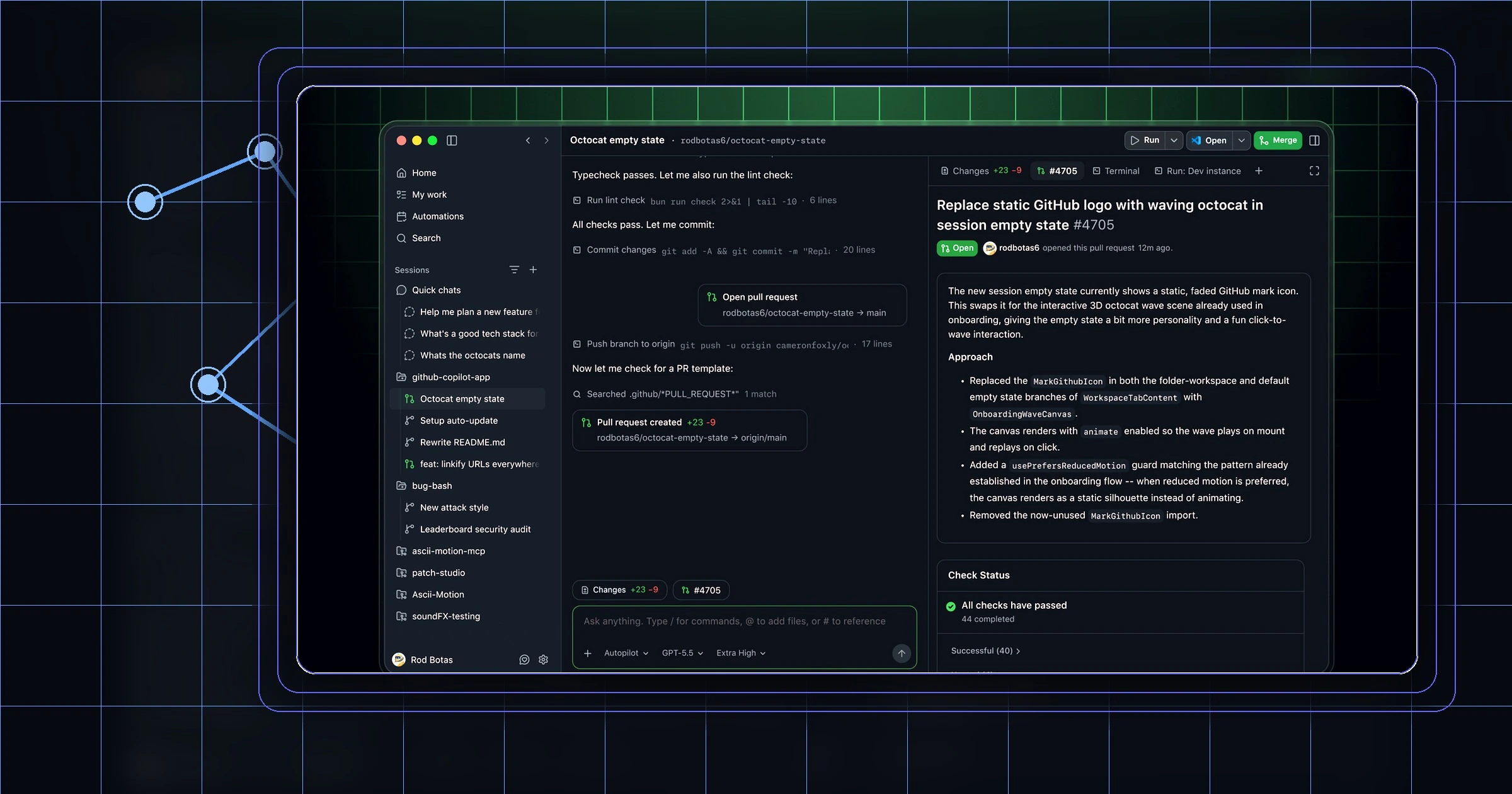
GitHub Copilot is finally starting to look like a product an enterprise can actually govern.
Until now, a lot of companies were trapped between two bad shortcuts. On one side, active seats as a lazy success metric. On the other, fear of surprise spend once agentic usage started scaling. What was missing was not only pricing. It was instrumentation.
The changes from the last few weeks go straight at that gap. On July 20, GitHub started showing AI credits used per billing cycle to end users even when no personal budget exists. The same day, it moved AI credit pool controls for cost centers into the billing UI. On July 22, it released an impact dashboard that tries to show not only who uses Copilot, but how deeply each cohort is adopting it and with what operational effect.
Put that together with usage-based billing and the message is clearer than before: Copilot is no longer just a seat license with a productivity aura around it. GitHub wants it to become a governable software-plus-compute line item.
What actually changed
The newest piece is the impact dashboard. For enterprise admins and organization owners, GitHub now groups users by adoption phase: passive, code-first, agent-first, and multi-agent or Copilot app. Instead of stopping at “who was active,” the dashboard shows average pull requests merged per user, median merge velocity, share of users by cohort, and average lines of code per day.
That matters because active seats alone barely answer the question that pays the bill. One team can distribute lots of licenses and still have shallow adoption. Another can concentrate heavy usage in a smaller group and create more actual leverage. The new panel is GitHub’s attempt to tell that story with less guesswork and less vendor theater.
This fits the broader Copilot pattern we have been watching. When I wrote about GitHub Copilot harness design and token-efficiency benchmarks, the real issue was already larger than model quality. It was operational efficiency. And when Claude Sonnet 5 landed in Copilot with a serious cost and governance angle, it became even harder to pretend that the platform question was only about model choice.
Now GitHub is trying to close that layer with more explicit measurement.
Variable cost just became less invisible
The most underrated step may not be the admin dashboard at all. It may be the usage page for the individual user.
Previously, many users only saw a percentage of a budget. If an admin had not set an individual budget, that page said very little about what a developer had actually consumed during the month. With the July 20 change, Business and Enterprise users can now see AI credits used in the current cycle even without a personal budget.
That changes the internal conversation in an important way.
When only finance or platform admins can see the cost signal, usage stays abstract. Once the user can see credits consumed, it becomes easier to connect behavior to cost. That is not mainly useful as punishment. It is useful as feedback. It helps teams learn where Copilot is buying real leverage and where it is just burning expensive context without a proportionate outcome.
This is the same maturity gap that showed up when GitHub tried to frame model availability and policy controls as mere catalog maintenance, which is why the post on GitHub Models retirement and the governance weight of fallback paths inside Copilot mattered. Without operational visibility, a company buys AI. With visibility, it starts managing a system.
A good budget is not just a cap. It is workflow design.
GitHub’s docs help separate a distinction many companies still blur.
A user-level budget is not the same thing as a cost center budget, which is not the same thing as an enterprise spending limit.
The user-level budget is the hardest control. It applies while included pool credits still exist and after usage becomes metered. If a user hits that limit, they are blocked. There is no automatic fallback to a cheaper model, and no cost center with spare capacity that rescues that person.
Cost center budgets and enterprise budgets work more in the phase where the shared pool is exhausted and additional usage starts getting billed. They control paid overage, not fairness inside the pool. And this is where a very practical detail matters: GitHub explicitly says Stop usage when budget limit is reached is not automatically the same thing as setting a number. If that option is not enabled, you may get a notification while paid usage continues.
That is the kind of detail that separates real governance from false confidence.
Cost centers just became more useful for serious pilots
Another meaningful improvement is that AI credit pools for cost centers are now manageable in the UI. Before this, the flow depended on the REST API. Now admins can enable it directly where they create and edit cost centers.
The practical effect is good for staged rollout.
You can build a Copilot pilot for a specific group, keep that group inside the AI credit pool funded by its own licenses, and decide whether usage should stop or roll into additional spend when the limit is hit. That makes it easier to test adoption without contaminating the rest of the company or turning a pilot into vague shared cost with no clean attribution.
It also improves ROI analysis. If a platform, security, or product cost center consumes more, you can start comparing that usage to pull-request throughput, delivery speed, automation gains, or reduced review churn. It does not solve attribution by itself, but it moves the discussion out of the dark.
The detail that changes how you should read the September bill
There is another point worth watching right now in late July.
GitHub is giving larger promotional included usage through September 1, 2026 to existing Business and Enterprise customers. On paper, that smooths the transition. In practice, it can also soften the bill in a way that hides what steady-state usage will look like later.
Right now, existing customers receive 3,000 AI credits per user in Business and 7,000 in Enterprise during the promotional period. After that, the standard base drops back to 1,900 and 3,900.
So if your rollout feels comfortably cheap right now, be careful. Part of that comfort may be coming from a temporary cushion rather than truly efficient usage.
Where to control without crushing adoption
The obvious temptation is to respond by setting a small budget for everyone. That usually teaches the wrong lesson.
If the goal is to stop cost blowups without killing adoption, the better starting point is three more honest questions.
First: which surfaces are actually driving consumption? GitHub itself reminds admins that code completions and next edit suggestions do not consume AI credits on paid plans. The heavier budget surfaces are chat, CLI, cloud agent, Spaces, Spark, and third-party coding agents. If spend is rising, the culprit is probably not basic autocomplete.
Second: who is using Copilot with meaningful depth and who is just experimenting noisily? The new cohort dashboard is well suited to that distinction.
Third: where does extra budget buy real time back, and where does it mostly buy expensive chaos? A developer who accelerates incident response, difficult refactors, or internal automation may justify a bigger budget. Diffuse usage with no visible outcome deserves a shorter leash and faster review.
Good governance does not try to flatten everyone to the same ceiling. It tries to learn where AI is buying real time and where it is only buying costly entropy.
The best use of this new control layer
If I were running a mid-sized or large Copilot rollout today, the checklist would be simple.
First, turn on real usage visibility and export data by user, model, organization, and cost center.
Then create cost centers for groups that already have clear objectives, such as platform engineering, the main product team, or internal automation.
Next, set initial user-level budgets that protect the pool without shutting down useful experimentation too early.
Finally, enable explicit hard stops for additional paid usage wherever the company really wants a firm ceiling.
The goal is not to turn Copilot into a paranoid cost center. It is to get out of the mode where a license looks like adoption, adoption looks like ROI, and nobody can explain where the money actually went.
GitHub has not solved everything. But with an impact dashboard, per-cycle AI credits visibility, and cost centers that are easier to operate, it has finally started delivering the missing layer that lets Copilot be managed like a platform instead of bought like a promise.
Sources
- GitHub Changelog, “New Copilot usage metrics impact dashboard”
- GitHub Changelog, “Copilot users can now see AI credits used per billing cycle”
- GitHub Changelog, “AI credit pools for cost centers in the billing UI”
- GitHub Docs, “Budgets for usage-based billing”
- GitHub Docs, “Usage-based billing for organizations and enterprises”
- GitHub Docs, “Managing your company’s spending on GitHub Copilot”