GitHub’s decision to expand MAI-Code-1-Flash across more Copilot surfaces looks small at first glance. It is not.
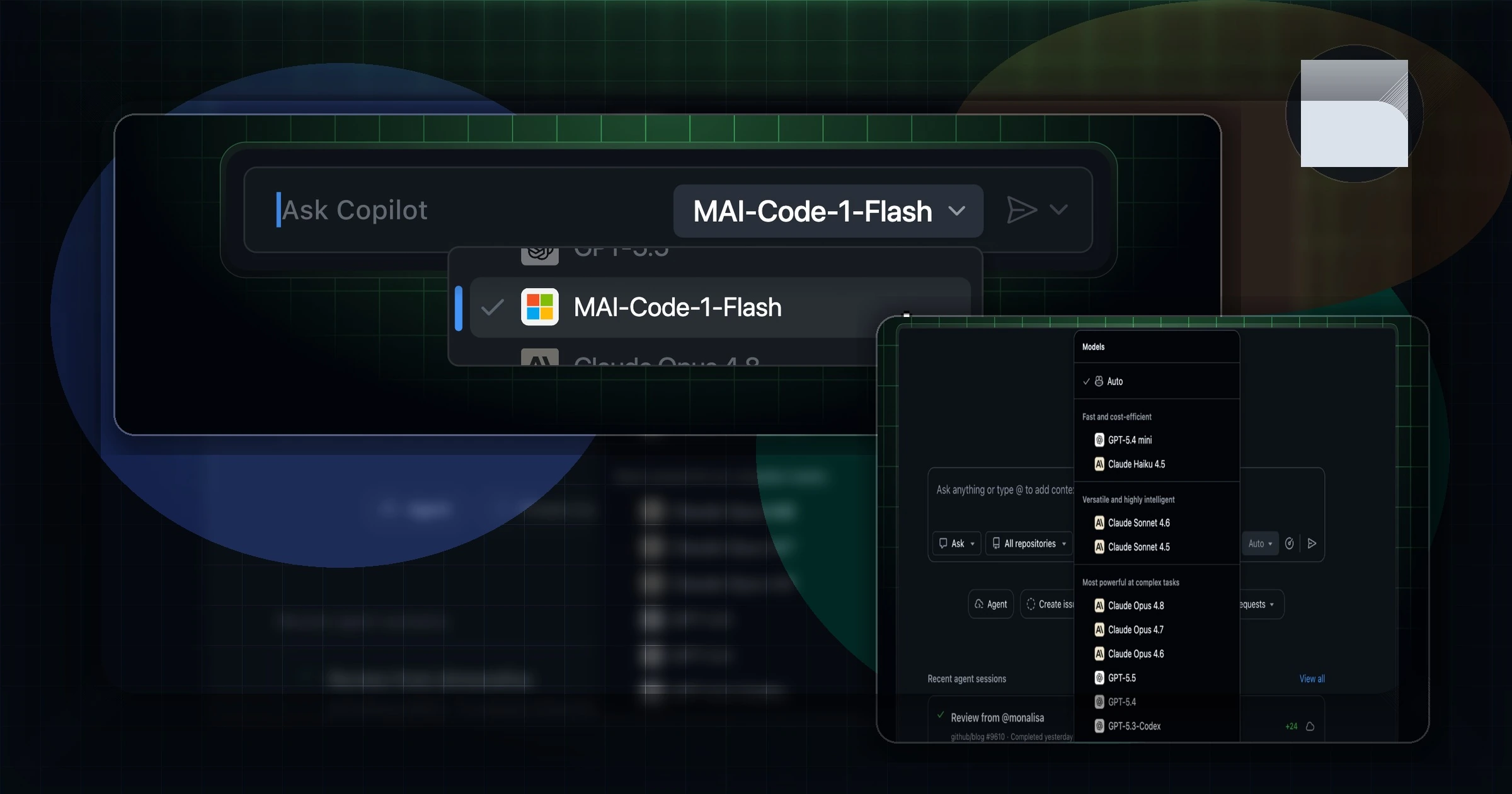
On June 18, GitHub said Microsoft’s MAI-Code-1-Flash is now becoming available on a much broader set of Copilot entry points: Copilot CLI, the GitHub Copilot app, Copilot Chat on GitHub, Visual Studio, GitHub Mobile, JetBrains IDEs, Eclipse, and Xcode. The rollout starts with a limited set of users and expands over the coming weeks. It is already available for Copilot Free, Student, Pro, Pro+, and Max, with Business and Enterprise support coming later.
That matters because model choice inside Copilot is no longer a novelty feature. It is becoming part of the operating model.
Once developers can reach the same lightweight coding model across the places where they actually work, the question changes from “what’s the smartest model?” to “what is the right model for this task, at this speed, at this cost?”
This is really a distribution story
The deeper story is that GitHub keeps turning Copilot into a multi-surface, multi-model system where the interface matters less than the routing and economics underneath. A model that exists only in one IDE is an experiment. A model that shows up in the CLI, on GitHub, on mobile, and in multiple desktop environments becomes workflow infrastructure.
GitHub describes it as Microsoft’s purpose-built small coding model, tuned specifically for Copilot and strong for its size in early testing. The phrase “for its size” is important. GitHub is not positioning MAI-Code-1-Flash as the universal best model. It is positioning it as the small, coding-focused option that can cover a large share of everyday work without forcing users onto heavier reasoning models.
That is why expanding surface area matters. Small models become strategically useful only when they are easy to choose when developers need quick assistance.
Why cost is now part of the model conversation
GitHub’s pricing docs make the underlying logic clearer.
MAI-Code-1-Flash is priced at $0.75 per 1 million input tokens, $0.075 for cached input, and $4.50 per 1 million output tokens. In Copilot terms, that places it in the lightweight tier. It is much cheaper than models such as GPT-5.4, GPT-5.5, Claude Sonnet 4.6, or Claude Opus-class options. It is priced similarly to GPT-5.4 mini, while sitting above ultra-cheap options like GPT-5 mini on raw token cost.
That alone would not be especially interesting if model choice were rare. But Copilot is increasingly used across chat, CLI workflows, coding agents, and code-adjacent research tasks. When those interactions multiply, the difference between a lightweight model and a heavyweight one stops being theoretical.
There is another important detail in GitHub’s billing docs: code completions themselves are not billed in AI credits. They remain unlimited on paid plans under their own counting mechanism. So the real cost pressure shows up more in chat-style and agent-style usage than in classic inline completion.
That makes the MAI-Code-1-Flash expansion more relevant than it first appears. GitHub is not just giving users another model name in a picker. It is giving them a lower-cost path for the interactions most likely to sprawl: ask-and-revise chat loops, CLI assistance, quick code transformations, explanations, and lightweight problem solving.
Latency is not a side benefit anymore
The model comparison docs make a broader point that applies here: some models are better for deep reasoning, while others win on lower latency and simpler tasks.
That sounds obvious, but Copilot’s product design is increasingly built around that distinction.
For a lot of developers, the most frustrating failure mode is not wrong output. It is interruption. A model that takes too long for simple edits, shell help, or quick code explanations breaks flow even if its final answer is technically better. Small coding models are valuable because they compress that wait time on routine work.
If you are in Copilot CLI asking for a command fix, in GitHub Chat summarizing a change, on mobile checking a repository question, or inside an IDE asking for a straightforward refactor, a smaller model with good coding priors can be the better product choice even when a larger model might produce a more impressive answer in the abstract.
In other words, MAI-Code-1-Flash is important not because it replaces frontier reasoning models, but because it protects developer flow from overkill.
The bigger context is Auto mode
This update also lands one day after GitHub announced that Auto mode in Copilot Chat is now available for all users on GitHub.com and GitHub Mobile.
GitHub is clearly pushing two ideas at once. First, users should have more explicit model options. Second, many users should not have to think about model choice all the time.
Auto mode chooses a model based on task complexity and current availability, and GitHub says paid subscribers get a 10% cost discount when using Auto in supported Copilot surfaces. The company frames Auto as a way to optimize token use, reliability, and quality without constant manual switching.
So where does MAI-Code-1-Flash fit?
It strengthens the manual side of the equation.
Auto is for convenience and system-level optimization. MAI-Code-1-Flash is for people who want a predictable lightweight coding model available across more of their daily workflow. Those are not competing ideas. They are two ways of managing the same reality: there is no single best model for every Copilot interaction anymore.
For some teams, the best default will be Auto plus policy controls. For others, especially solo builders and cost-conscious engineering teams, the better pattern may be to keep Auto available while deliberately choosing a cheaper, faster model for high-volume routine work.
What developers and engineering leads should take from this
The expansion of MAI-Code-1-Flash changes three things.
First, it makes lightweight model selection operationally credible. A model cannot help with cost or latency if it is only available in one corner of the product. GitHub is removing that problem.
Second, it reinforces that Copilot usage now has to be managed like a portfolio. Heavy reasoning models still matter for debugging, architecture, and ambiguous multi-step work. But a growing share of Copilot usage is repetitive, local, and speed-sensitive. That is where lightweight coding models earn their keep.
Third, it pushes Copilot closer to a world where model strategy becomes part of engineering management. Not in a dramatic governance-heavy sense, but in a practical one: which model should developers reach for first, when should Auto be preferred, and how much expensive reasoning do you actually need for common tasks?
That is a product question, but it is also a spend question.
The real significance
The most important thing about this release is not that MAI-Code-1-Flash exists. It is that GitHub is making it easier to use in the places where model economics become visible.
When a lightweight coding model is reachable across the CLI, GitHub, mobile, and more IDEs, developers are more likely to use it for the long tail of ordinary tasks that do not justify premium inference. That can improve responsiveness, reduce unnecessary model spend, and create a cleaner separation between “fast enough” and “reason deeply.”
That separation is becoming one of the defining decisions in AI-assisted development.
GitHub’s broader Copilot direction now looks increasingly clear: more models, more surfaces, more automatic routing, and more pressure on users to think in terms of tradeoffs rather than rankings.
In that environment, MAI-Code-1-Flash is not just another supported model.
It is part of the emerging default layer for practical coding assistance.
Sources
- GitHub Changelog, “MAI-Code-1-Flash available on more Copilot surfaces,” June 18, 2026: https://github.blog/changelog/2026-06-18-mai-code-1-flash-available-on-more-copilot-surfaces
- GitHub Docs, “Models and pricing for GitHub Copilot”: https://docs.github.com/copilot/reference/copilot-billing/models-and-pricing
- GitHub Docs, “AI model comparison”: https://docs.github.com/copilot/using-github-copilot/ai-models/choosing-the-right-ai-model-for-your-task
- GitHub Changelog, “Auto mode in Copilot Chat available for all users,” June 17, 2026: https://github.blog/changelog/2026-06-17-auto-mode-in-copilot-chat-available-for-all-users