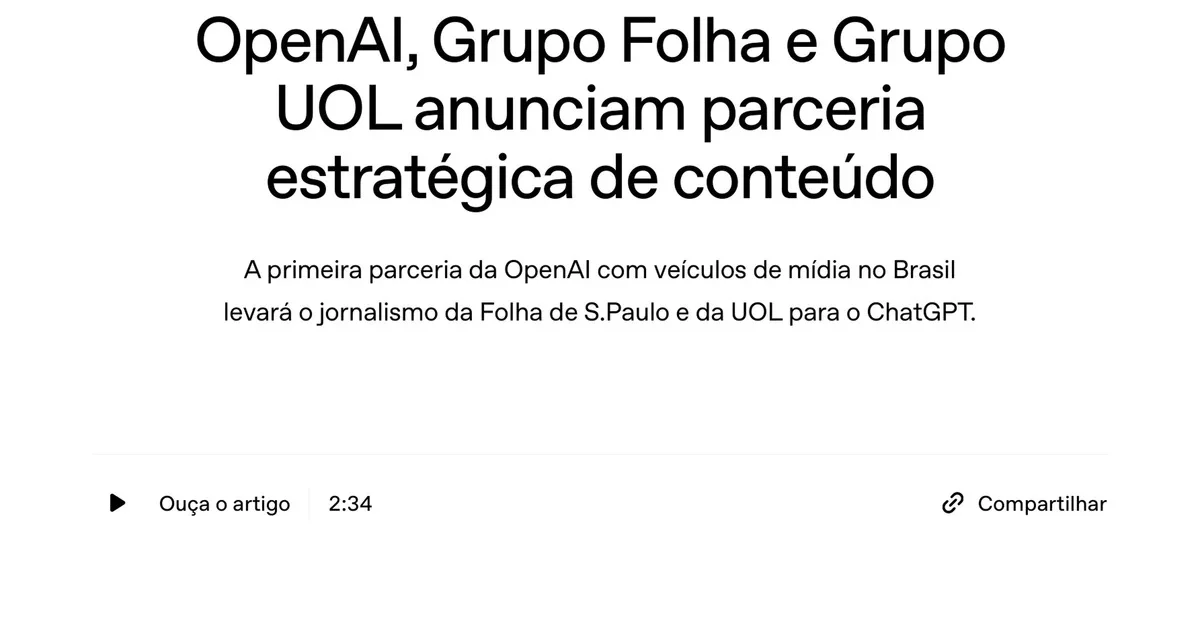
At first glance, the partnership between OpenAI, Grupo Folha, and Grupo UOL may look like just another content-licensing agreement. In Brazil, though, it signals something larger: ChatGPT’s formal entry into the news distribution chain with local editorial brands behind it, at a moment when attention, trust, and interface design matter as much as raw audience size.
This is OpenAI’s first media partnership in Brazil.
That alone would make it notable. But the real weight of the deal becomes clearer in context. OpenAI says ChatGPT now has more than 900 million weekly active users worldwide, over 50 million monthly active users in Brazil, and roughly 140 million messages per day in the country. When an interface operating at that scale decides to integrate professional Brazilian journalism with attribution and links to original reporting, it is not simply making answers richer. It is reshaping how people discover information.
That changes quite a lot.
ChatGPT becomes another front door to the news
For years, digital journalism revolved around a fairly stable architecture: homepages, search engines, and social platforms. Then came messaging apps, short-form video, and algorithmic recommendations. Now conversational interfaces are fully entering that map.
By partnering with Folha de S.Paulo and UOL, OpenAI turns ChatGPT into another distribution channel for Brazilian news and editorial context. Instead of starting on a publisher’s homepage, on Google, or inside a social feed, users can now begin with a question. From there, they may receive an answer that summarizes, contextualizes, and points them back to the original article.
That detail—attribution—matters.
The debate between AI companies and publishers has so far been defined by a central tension. Models want to be broad and useful; media companies want to preserve brand identity, traffic, recognition, and the economic value of their work. When OpenAI emphasizes transparency, attribution, and links to original sources, it is trying to address exactly that friction.
It does not resolve everything. But it does establish an important principle: AI does not have to function as a black box that absorbs content and returns a detached synthesis with no visible origin. It can also serve as an editorial discovery layer.
For Grupo Folha and Grupo UOL, that creates access to a new stream of potential audience, including readers beyond Brazil. For OpenAI, it improves the local product with trusted national sources. For users, it shortens the distance between a question and a credible reported answer.
Editorial legitimacy is as important as distribution
The most strategic part of the agreement may lie less in distribution than in legitimacy.
Generative AI has already proven that it can respond quickly. Speed was never the only issue. Trust was.
On news-related topics—especially in a country shaped by political polarization, heavy information noise, and an established disinformation ecosystem—it is not enough to produce a plausible answer. That answer needs to be anchored in recognizable, verifiable, editorially accountable sources.
That is where Folha and UOL matter as reputation assets.
When ChatGPT summarizes material based on their reporting and links users back to the source, OpenAI gains something technology alone cannot easily manufacture: institutional grounding. It is no longer just a matter of saying “the model knows.” It becomes possible to say that professional journalism stands behind the context being presented.
That distinction is enormous.
In the short term, it helps reduce the sense that AI answers come from nowhere. In the medium term, it supports a broader idea: AI interfaces can become systems of editorial mediation, not just machines for statistical text generation.
For the media groups, the symbolic value is significant as well. Being selected as local partners by a platform with ChatGPT’s scale acts as a signal of relevance. Sérgio Dávila’s comment that OpenAI’s interest reinforces the importance of professional journalism points in exactly that direction. The subtext is clear: if the new layer of access to information depends on trusted sources, the value of journalism does not disappear. It shifts position in the stack—and may even increase.
The battle for attention gets tougher
There is, however, another side to this story.
If ChatGPT becomes a gateway to information, it also becomes a competitor for attention.
Even with attribution and links, many users may be satisfied with the conversational summary and never click through to the original story. We have seen versions of this before with search snippets, social platforms, and short-form video. Convenience tends to capture part of the value before the user ever reaches the final destination.
In other words, the partnership may expand reach while also accelerating intermediation.
That is the paradox.
Publishers enter these deals to maintain presence inside the interfaces where audiences are moving. But by doing so, they also accept that the primary user experience may no longer be “read the article on the site.” Increasingly, it may be “get the answer inside the AI.” Traffic stops being the only strategic center. Brand recall, citation, recurring visibility, and influence become even more important.
In Brazil, that has major implications because the attention market is already fragmented by default. Audiences are split across portals, WhatsApp, Instagram, TikTok, YouTube, search, and now conversational tools. Publishers that stay out of these new layers risk losing relevance. Those that enter need to make sure they do not become invisible suppliers of context.
What makes the OpenAI–Folha–UOL agreement important is that it acknowledges this transition instead of pretending it is not happening.
Why this move makes sense in Brazil right now
Brazil is one of ChatGPT’s largest markets globally, which helps explain the timing.
With more than 50 million monthly active users in the country and around 140 million messages per day, the product has already moved beyond niche usage. It is becoming an everyday interface. Once that happens, the pressure for local relevance rises sharply.
OpenAI cannot compete for Brazilian attention with a product built only on generic or international context, disconnected from the national news cycle. It needs reliable local content to make its answers more useful in Brazil.
At the same time, major media groups need to be present where attention is being reorganized.
That makes the partnership a pragmatic convergence of interests.
It is also notable that the deal goes beyond content distribution. Grupo Folha and Grupo UOL will gain access to Codex, ChatGPT Enterprise, and the API. That points to a second strategic layer: this is not only about placing journalism inside ChatGPT, but also about bringing AI into newsroom operations, internal workflows, products, and experimentation.
In that sense, the agreement works both externally and internally.
Externally, it creates a new channel for reach and reputation. Internally, it provides infrastructure for testing new editorial formats, automation systems, and AI-enhanced products.
What this signals to the market
The clearest signal may be this: the relationship between AI and journalism in Brazil is moving out of its abstract phase and into an institutional one.
Until now, much of the discussion revolved around fear, litigation, scraping, traffic decline, and replacement risk. None of those concerns has disappeared. But agreements like this suggest that at least part of the market is beginning to test a more concrete path: integrate, license, attribute, and compete for relevance within the new interface—not only against it.
That does not mean the conflict is over.
It means the negotiation has become more sophisticated.
The key question is no longer whether AI will use journalistic content. It is under what terms, with what degree of visibility, with what economic return, and with what role for the editorial brand.
In Brazil, Folha and UOL are now among the first major players to define those terms in practice. And by signing its first media deal in the country with two heavyweight groups in both journalism and audience reach, OpenAI is signaling that it understands a basic reality: technological scale helps, but local legitimacy remains indispensable.
The bigger picture
In the end, this partnership matters less as corporate news than as a clue about where the market is heading.
It shows that ChatGPT wants to become more than an answer engine. It wants to become an environment for information discovery, supported by recognized journalistic brands.
It shows that publishers understand the battle for attention is already moving inside AI interfaces.
And it shows that in Brazil, editorial legitimacy is still too scarce—and too valuable—to ignore.
The competition now is not just for traffic.
It is for qualified presence at the exact moment a user asks a question.
The organizations that can occupy that space with credibility will carry a meaningful advantage into the internet’s next phase.