Alibaba released the weights of Qwen3.8-27B under Apache 2.0 last Friday. It’s a dense 27-billion-parameter model with native vision (images and video), per-request adjustable reasoning, and a 262K context window extensible to 1 million tokens. According to Alibaba’s own benchmarks, it matches — and in some tests surpasses — Anthropic’s Opus 4.6 running at Max setting.
This matters for a simple reason: 27B dense is a size that fits on consumer hardware. It’s not a 2.4-trillion-parameter MoE that only runs in a data center. It’s a model you can, in theory, run on your MacBook Pro.
What the benchmarks show
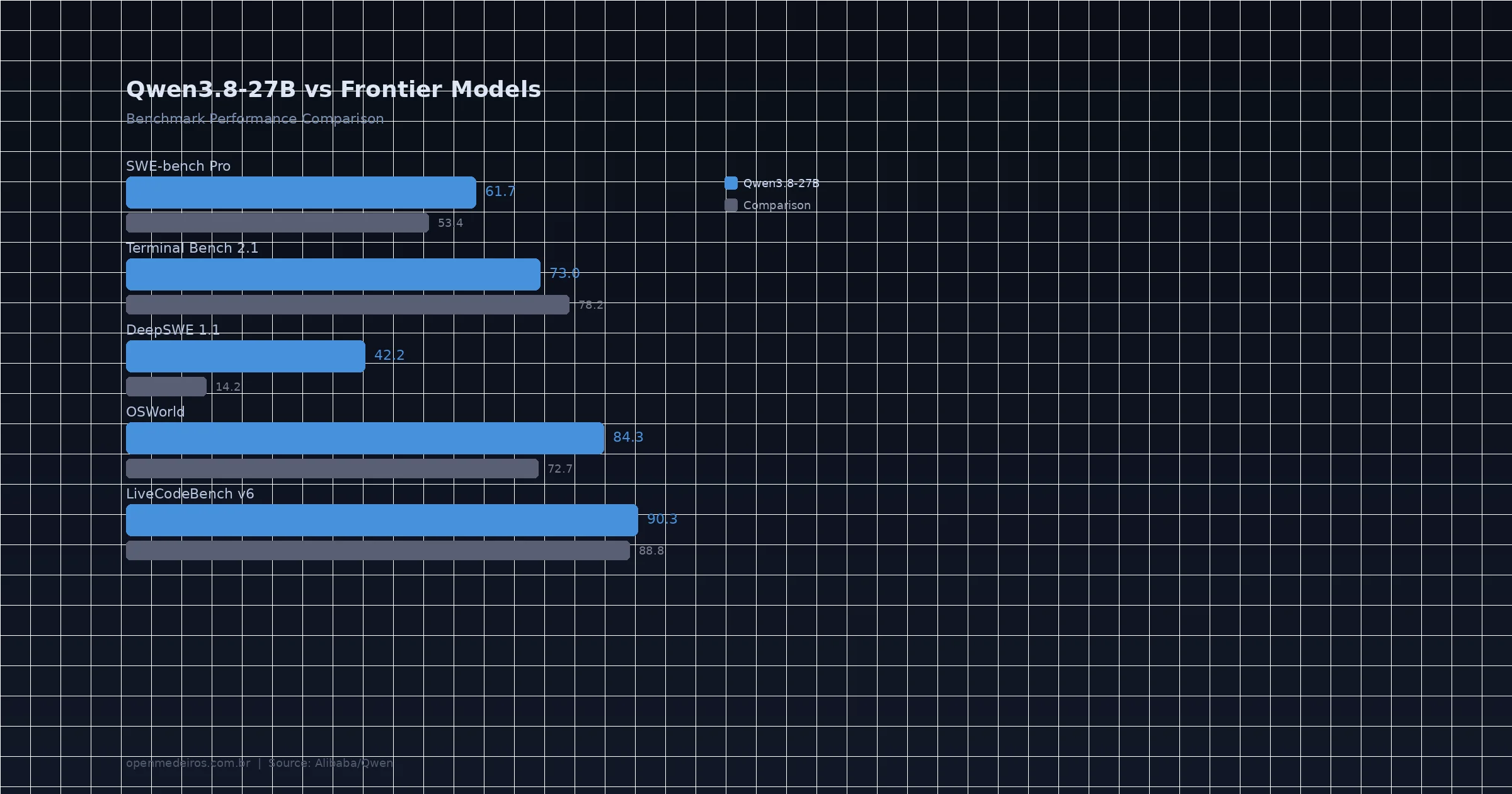
Alibaba’s reported numbers place Qwen3.8-27B in a surprisingly strong position against frontier models:
- SWE-bench Pro (agentic coding): 61.7 vs 53.4 for Opus 4.6 Max — an 8-point lead over a model that was state-of-the-art six months ago.
- Terminal Bench 2.1 (agentic terminal coding): 73.0 vs 78.2 for Opus 4.6 Max — Opus still wins here, but the margin is small for a model 10x smaller.
- DeepSWE 1.1: 42.2, a massive jump from the 14.2 of the previous-generation Qwen 3.6-27B.
- OSWorld (computer use): 84.3 vs 72.7 for Opus 4.6 Max — Qwen wins comfortably.
- LiveCodeBench v6: 90.3, beating Opus 4.6 Max’s 88.8.
The model also outperforms Meta’s Muse Glimmer-30B on every test where both have reported scores. And it comes with native vision-language capability, making it useful for tasks involving screenshots, diagrams and documents — something many local models don’t offer.
What the benchmarks don’t show
Before you cancel your API subscription, it’s worth understanding what these numbers mean in practice.
First: the benchmarks are from the original checkpoint, not the quantized versions most local users will run. The unquantized model is 55.6GB — nobody with a regular laptop is loading that. The 4-bit MLX version, already available on Hugging Face, is ~16GB and can run on a Mac with 32GB of unified memory. But quantization always has a quality cost. The difference between 4-bit and original BF16 may be small on simple tasks, but in long-horizon reasoning and agentic coding, where every reasoning token matters, degradation can be noticeable.
Second: early community reports on Hacker News indicate the model tends to “overthink” — spending many reasoning tokens before responding. Qwen3.8 ships with thinking mode enabled by default and a reasoning_effort parameter to adjust depth (xhigh, medium, low). On simple tasks, this means unnecessary latency. On complex tasks, it may mean more quality, but also more token consumption and memory usage.
Third: agentic coding benchmarks depend as much on the harness as on the model. Alibaba itself evaluates with the Claude Code harness, meaning part of the performance comes from the scaffold, not just the model. If you run the model in a different harness — vLLM with your own agent, LM Studio, Ollama — results may vary.
What you need to run it locally
The good news is the ecosystem is already ready. MLX conversions for Apple Silicon exist, with 4-bit (16.1GB) and 8-bit (29.5GB) versions. vLLM and SGLang have official recipes. Docker Model Runner supports it natively.
The ideal hardware depends on what you want to do:
- Mac with 32GB: runs the 4-bit version with moderate context. Works for short tasks, but the key-value cache grows as the prompt increases, and 32GB can get tight in long sessions.
- Mac with 48GB or 64GB: comfortable space for 8-bit or larger context. This is the sweet spot for serious use.
- NVIDIA GPU: the BF16 model needs at least one GPU with 64GB VRAM (or two with 32GB each). GGUF quantizations for llama.cpp reduce this, but at a quality cost.
For most developers, the most practical path is the 4-bit MLX version on a Mac with 32GB+, or using the hosted version on Qwen Cloud when available — Alibaba confirmed Qwen3.8-27B will have a hosted version with 1M context and built-in tools.
Is it worth the switch?
The answer depends on your use case. If you’re paying for Opus 4.6 or GPT-5 API for coding and agentic tasks, and you have a Mac with 48GB+, it’s worth testing Qwen3.8-27B locally. The cost is zero after download, latency can be lower than API (no network round-trip), and you control your data.
If you need native vision in a local model — to analyze screenshots, technical diagrams, documents — Qwen3.8-27B is one of the few open-weight options in this size class with real VL capability. The Gemma 4 12B also offers local multimodality, but in a different performance tier.
If you’re evaluating API cost vs self-host at scale, remember that 27B dense consumes more memory and is slower per token than a similarly-sized MoE. There’s no MoE version of Qwen3.8-27B yet, which limits throughput in production. For a framework on this cost trade-off, the post on AI model routing has useful guidance.
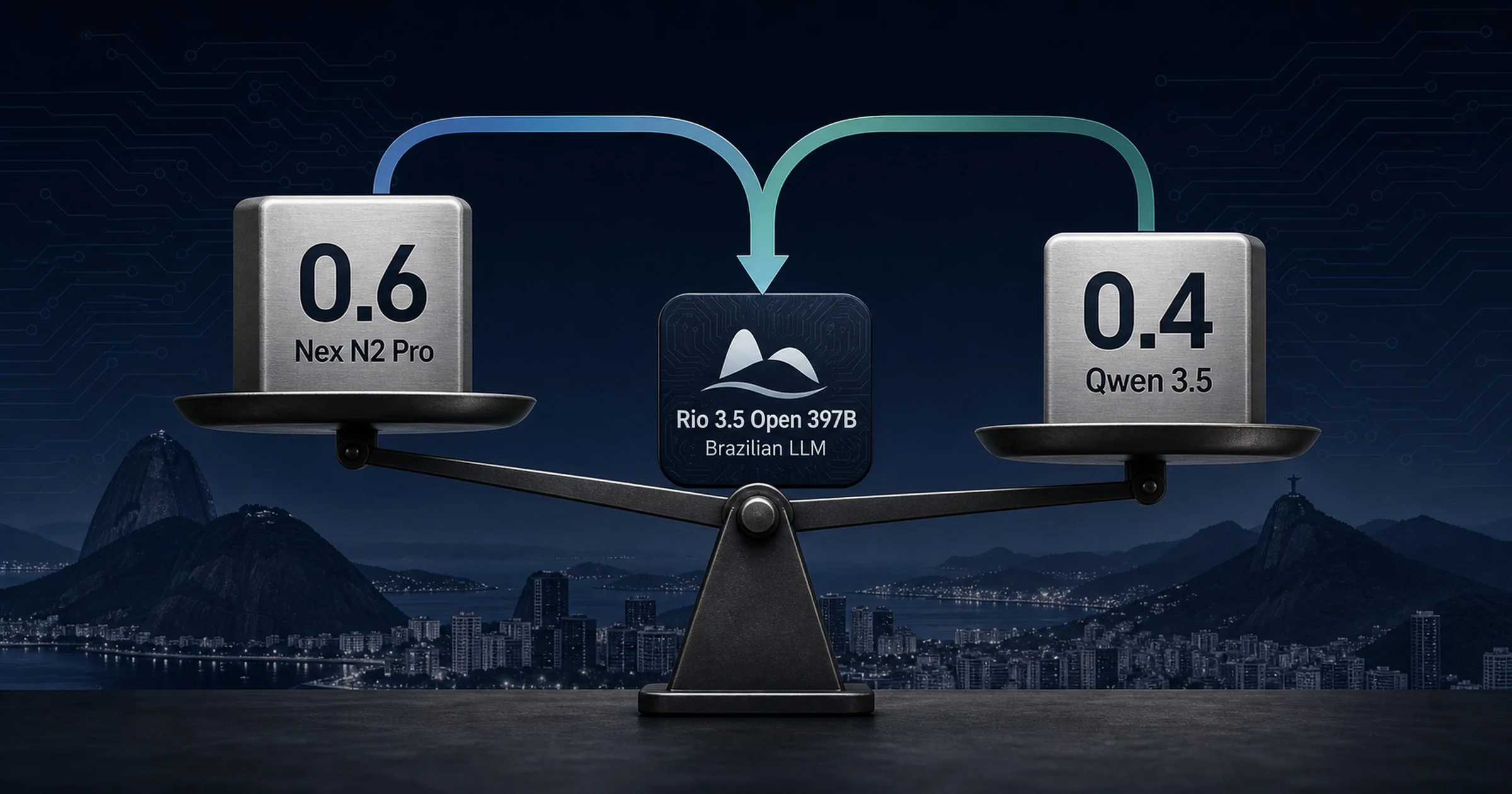
And if you’re just curious about what Alibaba is building with the Qwen family, it’s worth noting the line already drew attention before — the Rio 3.5 Open, which went viral as a “Brazilian LLM,” was based on a merge with Qwen 3.5. Alibaba is betting hard on open-weights as an adoption strategy.
The bigger picture
Qwen3.8-27B doesn’t exist in a vacuum. It arrives in a week where Meta launched Muse Code (a cheap coding agent), DeepSeek open-sourced an agent harness, and Opus 4.6 — which Qwen claims to beat — was released six months ago and is no longer the absolute frontier. The open-source LLM market is moving fast, and the gap between closed and open models is shrinking at an accelerating pace.
The most interesting point isn’t whether Qwen3.8-27B is “better” than Opus 4.6. It’s that a 27B model you can run on your laptop is in the same conversation as a model that costs tens of dollars per million tokens via API. Six months ago, that didn’t happen.
For developers who want sovereignty over their models, need native vision locally, or are tired of depending on API for every coding task, Qwen3.8-27B is the most relevant open-weight model to appear in 2026 so far. It’s not perfect, it’s not fast enough on consumer hardware for high-throughput production, and the benchmarks need to be taken with caution. But it’s a milestone.
Text produced with assistance from Javi, my AI agent. Curated by me — Rhuan Medeiros.