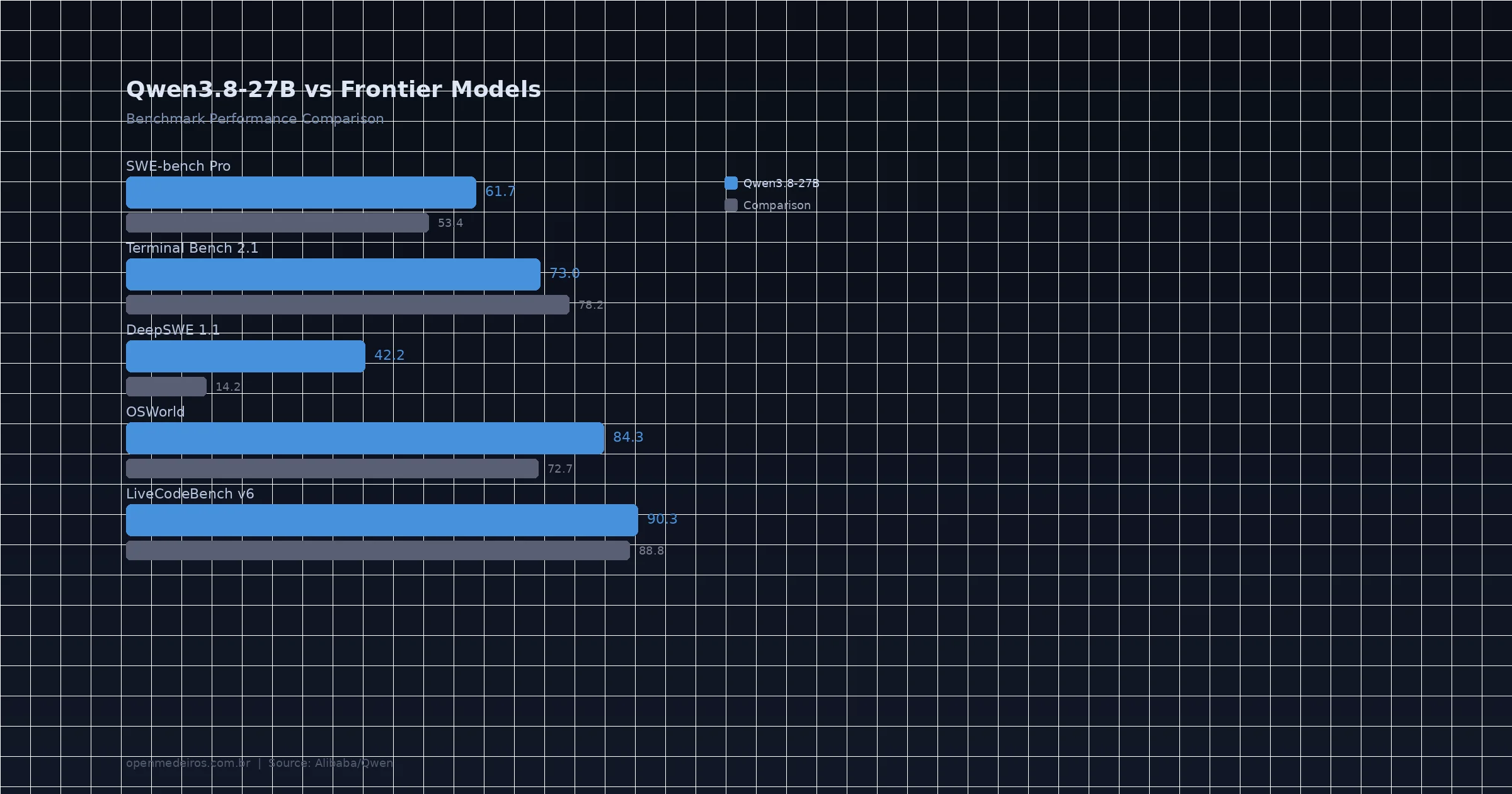
Alibaba’s new model arrives with a pitch that is less about isolated answers and more about sustained execution: using tools, holding context over long stretches, and serving as a foundation for autonomous systems.
When a new language model launches, the discussion usually revolves around benchmarks, speed, or cost. With Qwen3.7-Max, the most interesting point seems to be somewhere else. Alibaba introduced the model as a system built for the agent era: one in which AI does not simply answer a prompt, but plans, uses tools, consults files, executes multi-step tasks, and keeps working over long periods.
That emphasis matters because it changes what we are supposed to expect from the model. Instead of asking only whether it “sounds good,” the more relevant question becomes whether it can operate in real environments with dependencies, checks, and chained decisions. That is where Qwen3.7-Max appears to be trying to distinguish itself.
a model designed to act, not just respond
In its official launch material, Alibaba describes Qwen3.7-Max as an “agent foundation” — a base for agents that can write and debug code, automate office workflows, and sustain autonomous execution across hundreds or even thousands of steps.
In practice, that means treating the model less like a conversational interface and more like a system connected to tools. It needs to edit files, call APIs, move through workflows, and keep advancing when a task cannot be completed in a single reply.
That framing is important because agents do not usually fail for lack of fluency. More often, they fail because they lose the objective, repeat steps, or stop too early. Qwen3.7-Max is being presented as a response to exactly that kind of weakness.
the core of the pitch is tool use
One of the clearest signals of that difference is how Alibaba describes the model’s use cases. Qwen3.7-Max is positioned as an engine for coding agents, productivity automation, MCP orchestration — via the Model Context Protocol — and even multi-agent setups.
That means the model’s value does not lie only in generating text. It lies in knowing when to call a tool, how to interpret the result, when to revise its approach, and how to chain actions until it reaches something verifiable. That behavior is closer to a digital operator than to a traditional chatbot.
The public documentation also highlights compatibility with protocols and interfaces already used across the agent ecosystem. In Alibaba’s Model Studio, Qwen3.7-Max appears with APIs compatible with widely adopted formats, along with integration into frameworks and coding assistants. In practical terms, that lowers the friction for teams that want to test the model inside an existing workflow.
what stands out most: real long-horizon autonomy
Alibaba pointed to one specific case that helps clarify the ambition behind the launch. According to the company’s official materials, Qwen3.7-Max was tasked with autonomously optimizing an attention kernel in an environment that was not part of its training data, without detailed hardware documentation, and starting from an empty workspace that included only a task description, an existing implementation, and an evaluation script.
The headline figure is this: about 35 hours of continuous execution, with 432 kernel evaluations across 1,158 tool calls. According to Alibaba, the model wrote code, compiled it, profiled performance, fixed errors, investigated bottlenecks, and redesigned parts of the solution along the way. The company says the final result delivered a 10x geometric improvement over the reference implementation used in the test.
This is a vendor-described experiment, so it should be read as a published demonstration rather than a broadly validated third-party result. Even so, it is relevant because it points to a change in scale in what we expect from an agent. Instead of a few minutes of execution with a handful of calls, the story here is one of operational persistence: continuing to work and produce useful progress after many hours.
External coverage reinforced that framing. Reporting on the launch during Alibaba’s conference in Singapore, Computer Weekly highlighted Qwen3.7-Max as a model aimed at agentic workflows, with a 1 million-token context window and the ability to operate autonomously for up to 35 hours, according to company executives.
a 1 million-token context window is more than a flashy spec
A 1 million-token context window can sound like just another oversized specification, but in the context of agents it has a practical effect. Agents have to manage decision history, logs, large files, documentation, tool outputs, and successive versions of the same plan. The longer the job runs, the more likely context becomes a bottleneck.
With a window that large, Qwen3.7-Max can keep more material available inside the same reasoning cycle: repository excerpts, long reports, previous tool outputs, and session memory. That does not eliminate the need to summarize or organize information. But it does reduce the pressure to discard important elements too early.
Alibaba also mentions a feature called preserve_thinking, recommended for agentic tasks, which keeps the reasoning content from earlier interactions inside the message history. That suggests a concern not only with the final answer, but with the stability of the process across multiple rounds.
framework integration is part of the story
Another reason Qwen3.7-Max feels different is how it was introduced to the ecosystem. The launch was not framed around the model alone. Alibaba emphasized compatibility with agent frameworks and assistants already in use, as well as APIs in familiar formats.
That choice sends a simple message: the model is not being sold only as the endpoint of an interaction, but as execution infrastructure. For teams working with agents, that matters a great deal. The payoff comes when a model can slot into existing pipelines, communicate with orchestrators, handle external calls, and operate inside an observable loop.
Put differently, Qwen3.7-Max seems to have been launched with a concern that is less abstract and more operational. The implicit question is not “does it answer well?” but “can it be put to work inside a real system?” The combination of heavy tool use, very long context, and framework integration points squarely in that direction.
closing thoughts
Qwen3.7-Max stands out because it shifts the focus from the traditional language model toward an execution model. Alibaba is saying, quite directly, that the system’s value shows up when it stops being merely a response generator and starts functioning as a foundation for agents that plan, use tools, persist through long tasks, and maintain coherence throughout the process.
Independent testing and production results will still matter. But based on what has been announced so far, Qwen3.7-Max looks different for a clear reason: from day one, it has been positioned as a model for sustained agentic work. And that changes the kind of problem we expect a model to solve.
sources
- Alibaba Cloud. Qwen3.7: The Agent Frontier
- Alibaba Cloud. Alibaba Announces Comprehensive Full-Stack AI Upgrade for the Agentic Era
- Computer Weekly. Alibaba unveils Qwen 3.7 Max at inaugural Singapore conference
- MarkTechPost. Qwen Introduces Qwen3.7-Max: A Reasoning Agent Model With a 1M-Token Context Window