Rio 3.5 Open 397B was launched on June 13, 2026 by IplanRIO, the technology company of Rio de Janeiro’s city government. The launch was ambitious: Brazil’s first frontier-class LLM, 397 billion parameters, open license, with a proprietary reasoning layer called SwiReasoning. The declared cost, around R$ 500k (~$95k USD), made headlines. The published benchmarks suggested performance above Qwen 3.5 and DeepSeek on reasoning tests.
Twenty-four hours later, the picture was different.
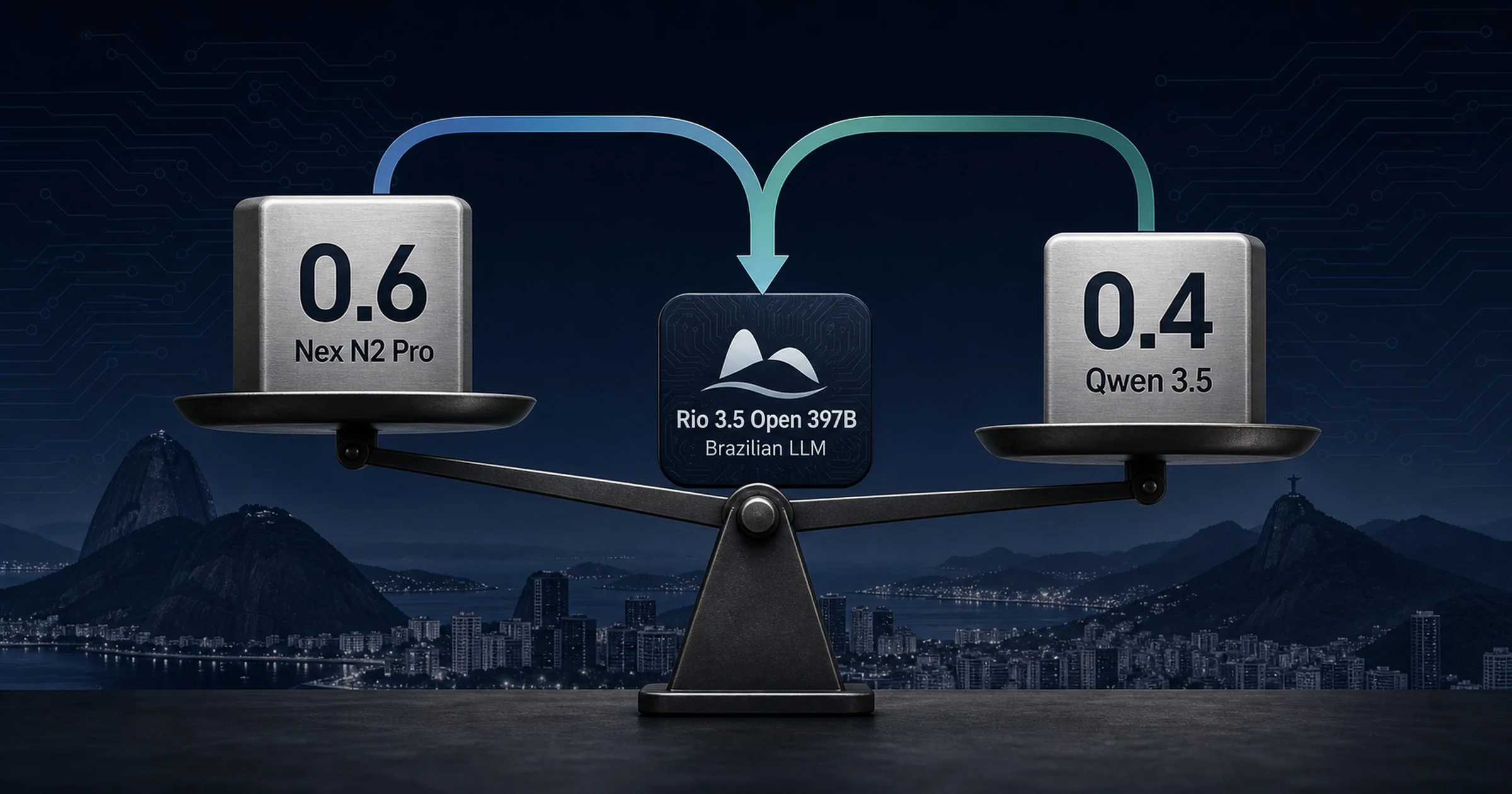
Nex-AGI, the team behind Nex N2 Pro, opened a public GitHub issue with the weight arithmetic. The math is direct: Rio 3.5 ≈ 0.6 × Nex N2 Pro + 0.4 × Qwen 3.5 397B. This is not an approximation. The equation is exact, validated by two independent element-wise analysis paths. Nex N2 Pro had been released about a week before Rio 3.5, which makes it unlikely that IplanRIO’s work preceded Nex-AGI’s.
IplanRIO’s official statement admitted what it called an “incorrect upload” of the published version and claimed the “real” weights were lost. The defense was as hard to swallow as the case itself: a 397B model with months of municipal work does not disappear because of a wrong upload. Hacker News, Reddit, YouTube, and international media (including Yahoo/Tech) replicated the finding within hours.
what a model merge is, and why it is so much cheaper
Model merge is not fraud in itself. It is a legitimate and useful technique: you take two or more already-trained models, and combine the weights by an element-wise operation — usually weighted average, but it can also be sum, SLERP, TIES, or DARE. The result is a model that inherits capabilities from the parents, sometimes with new strong points, and can be further tuned with relatively cheap techniques.
The important detail: the cost is a tiny fraction of pre-training cost. An element-wise merge of 397B models can be done in hours, on a single machine with enough VRAM, using open tools. Training a 397B from scratch, even with heavy distillation and curated datasets, requires GPU clusters for weeks and a different order of budget.
There is nothing wrong with doing a merge. There is something wrong with presenting a merge as training, especially when you suggest R$ 500k of public spending and a municipal AI foundation behind it.
why this case is not “just one more”
The sensitive point is the credit chain. The open source ecosystem of large models — Qwen, Llama, DeepSeek, Mistral, Nex, Gemma — works on the basis of explicit attribution. You take a base model, declare it, fine-tune on top, publish the derivation. The base model authors gain adoption, feedback, and reputation. Without this chain, the incentive to train and open a large model disappears.
IplanRIO did not cite Nex-AGI or Qwen/Alibaba in the model card. That is the core problem. The project’s Hugging Face page, prefeitura-rio/Rio-3.5-Open-397B, was taken down afterwards, but the evidence was already replicated.
Calling this an “upload error” underestimates the reputational cost. For the BR ecosystem, the real damage is in another direction.
what this changes for the next BR model
The next time a Brazilian team announces a large LLM, the community’s first question will not be “how did it benchmark”. It will be “show me the loss curve, the token budget, the cluster used, the dataset license”. Without verifiable evidence, the benefit of the doubt evaporates.
This is bad for serious projects that follow. Anyone will carry the weight of proving innocence before showing work. And it is particularly bad for distillation and merge — which, as we discussed in the case of Gemma 4 as a local multimodal model, are real and legitimate paths for smaller teams to participate in the game.
The honest path is simple: declare what is a merge, what the weights are, what the license is, and give credit. It is not weakness — it is how the ecosystem expects you to work. That is what OpenAI showed in the third-party evaluations playbook: the more open, the more credibility.
the part nobody wants to say out loud
The irony is that, if Rio 3.5 had been announced as “a municipal model based on Nex N2 Pro + Qwen 3.5, with a reasoning layer fine-tuned on public data”, the headline would be different. It would be a case of technical sovereignty via integration, with R$ 500k justified and a respected credit chain. The technical community would understand, the press would cover it properly, and the legacy would be different.
Instead, the damage is one of credibility — and it hits whoever comes next. When the next serious BR project appears, part of the public conversation will be about Rio 3.5. That is the real cost of the shortcut.
The work of the Nex-AGI and Alibaba/Qwen teams is what actually moves the open frontier today — worth remembering what Qwen 3.7 Max showed about the new generation of open models for agents. Credit to them, not to IplanRIO.