For months, the coding-agent conversation kept collapsing into the same shallow question: which model is smartest? GitHub’s new post about the Copilot agentic harness is an attempt to move the discussion somewhere more useful.
The company is not just saying it has access to strong models. It is saying the layer that controls context, tool access, loop behavior, and token burn may be where the real product advantage now lives. That is a much more mature claim—and probably a more accurate one.
It also fits a reality many teams are already feeling. Once coding agents move from curiosity to daily workflow, the relevant metric stops being “which answer looked cleverest?” and becomes “which system finished the task with acceptable cost, latency, and consistency?” That is the same pressure behind the hidden cost story we already covered: agent economics catch up with the product faster than most teams expect.
What GitHub measured
In the June 25 post, GitHub compares Copilot CLI against the model vendors’ own harnesses: Claude Code for Claude Sonnet 4.6 and Claude Opus 4.7, and Codex CLI for GPT-5.4 and GPT-5.5.
GitHub says it normalized the comparison around the usual variables that can distort results: same model, same task, normalized context window, comparable reasoning effort, tool selection, and MCP-server setup. The benchmark set includes SWE-bench Verified, SWE-bench Pro, SkillsBench, TerminalBench, and an internal Windows benchmark called Win-Hill.
The headline claim is straightforward. GitHub says Copilot’s harness delivered task-resolution on par with the native model-vendor harnesses, while consuming fewer tokens across many of the tested configurations.
That is not a trivial distinction. Plenty of developer tooling still talks as if the model alone determines the outcome. In practice, the user experiences the whole system: prompt shaping, context packing, tool invocation, retry patterns, loop control, and stopping behavior. Those choices can make an expensive model feel wasteful or a cheaper model feel surprisingly competent.
The harness is not plumbing anymore
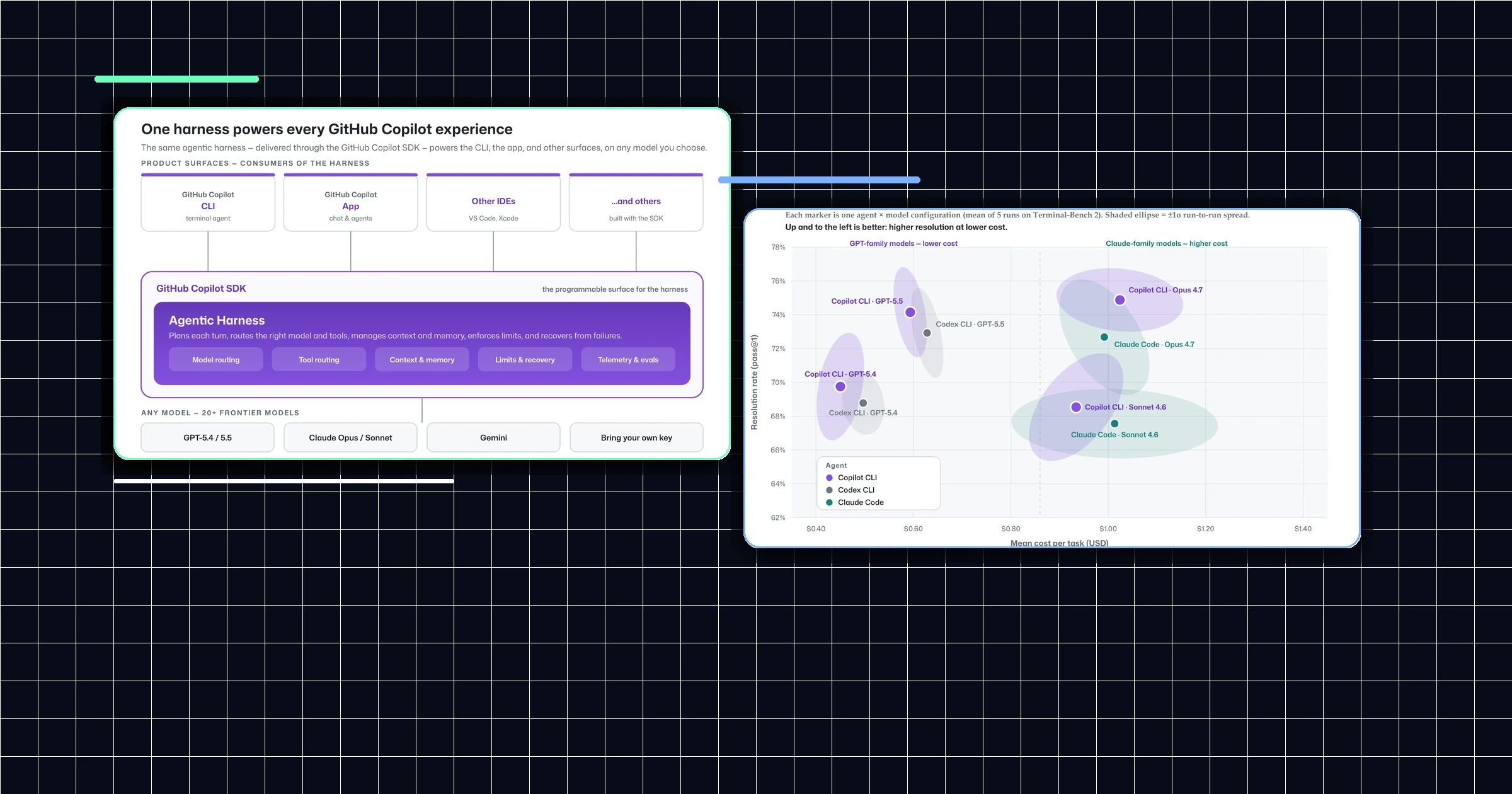
GitHub’s benchmark story becomes more persuasive when you read it next to the May VS Code blog post on the coding harness behind Copilot. That piece makes the architecture point clearly: the model is not the thing editing files, validating tool arguments, running terminal commands, or deciding whether the loop should continue. The harness does that.
In other words, the harness is where three important product decisions happen.
First, it decides what the model gets to see. Second, it decides which tools the model is allowed to use. Third, it decides how the think-act-observe loop is executed and constrained.
That sounds technical, but it is exactly where product quality is won or lost. A model can be brilliant in isolation and still feel mediocre inside a weak harness. Conversely, a strong harness can make a good model feel much more reliable because it reduces wasted context, noisy tool usage, and unstable iteration.
That is also why the harness argument matters beyond the CLI. The same underlying logic now shapes multiple Copilot surfaces and workflows, which is part of what makes something like Copilot App Agent Finder strategically interesting. Once a product spans multiple agents, modes, and model families, orchestration becomes part of the moat.
GitHub is really arguing about economics
The most revealing word in the benchmark post is not performance. It is efficiency.
GitHub highlights TerminalBench 2.0 variance analysis and says it ran each agent-model combination at least five times. The chart it presents suggests a familiar trade-off: GPT-family configurations offered the strongest value profile, combining good resolution with the lowest cost per task, while Claude Opus reached the highest resolution at a premium.
That is the kind of trade-off serious teams actually need to understand.
A lot of AI product messaging still focuses on absolute peaks. But engineering organizations rarely buy peak numbers in isolation. They buy throughput, predictability, and acceptable unit economics. If two systems resolve tasks at roughly similar rates, the one that burns fewer tokens across thousands of daily interactions may be the better product even if it is not the flashy winner in a screenshot war.
That is why GitHub’s multi-model framing matters. The company says the Copilot harness supports more than 20 frontier models across GPT, Claude, Gemini, and MAI families, plus bring-your-own-key for open-source and local models, as well as auto model selection. The business implication is clear: product value may come from routing work intelligently, not from betting everything on one supposedly superior engine.
The benchmark is useful—but not magical
None of this means the post should be read as a universal victory lap.
GitHub is still presenting a benchmark package with its own methodology, its own task mix, and its own reporting decisions. The post explicitly talks about stochastic variance and benchmark normalization. In smaller benchmarks, it says five independent runs were performed and the best-scoring run was reported.
That does not make the work invalid. It just means the right takeaway is narrower than “Copilot wins everything.” The stronger takeaway is that harness quality has become benchmarkable product surface. That alone is a meaningful shift in how coding-agent vendors are competing.
It is also consistent with the VS Code team’s own framing: the model is the engine, but the harness is the car. That sounds like marketing until you look at how real agent sessions fail. They usually fail on context, tool use, bad loop behavior, or unstable task decomposition long before they fail on raw text generation.
What developers should do with this
The practical lesson is not to memorize benchmark charts. It is to upgrade the way you evaluate agent products.
Look at cost per completed task, not just perceived cleverness. Test different models on the actual mix of work your team runs. Ask which product exposes enough control over tool usage, context behavior, and model routing to keep costs under control when usage scales.
Also pay attention to the operational environment around the model. That is the same pattern we saw in GitHub’s accessibility agent case: what makes an agent useful is not just what it can say, but whether it can move through a workflow with enough structure and reliability to be trusted.
The same logic shows up in parallel development workflows too. Stable context, isolated sessions, and predictable execution matter more once multiple agents and branches are active at the same time. That is why git worktrees are becoming more central again. The infrastructure around the agent is no longer a background concern. It is part of the product outcome.
A more mature competitive story
The best thing about GitHub’s post may be that it makes the coding-agent market sound slightly more adult.
Instead of pretending the whole fight is about frontier-model IQ, GitHub is competing on a less glamorous but more consequential layer: benchmark discipline, token efficiency, model routing, and harness design. That may be less exciting in social media format, but it is much closer to how durable product advantages are actually built.
If GitHub’s thesis holds, the next meaningful edge in coding agents will not come only from access to a better model. It will come from building a better system for turning good models into repeatable, economical work.
Right now, that system has a name: harness.